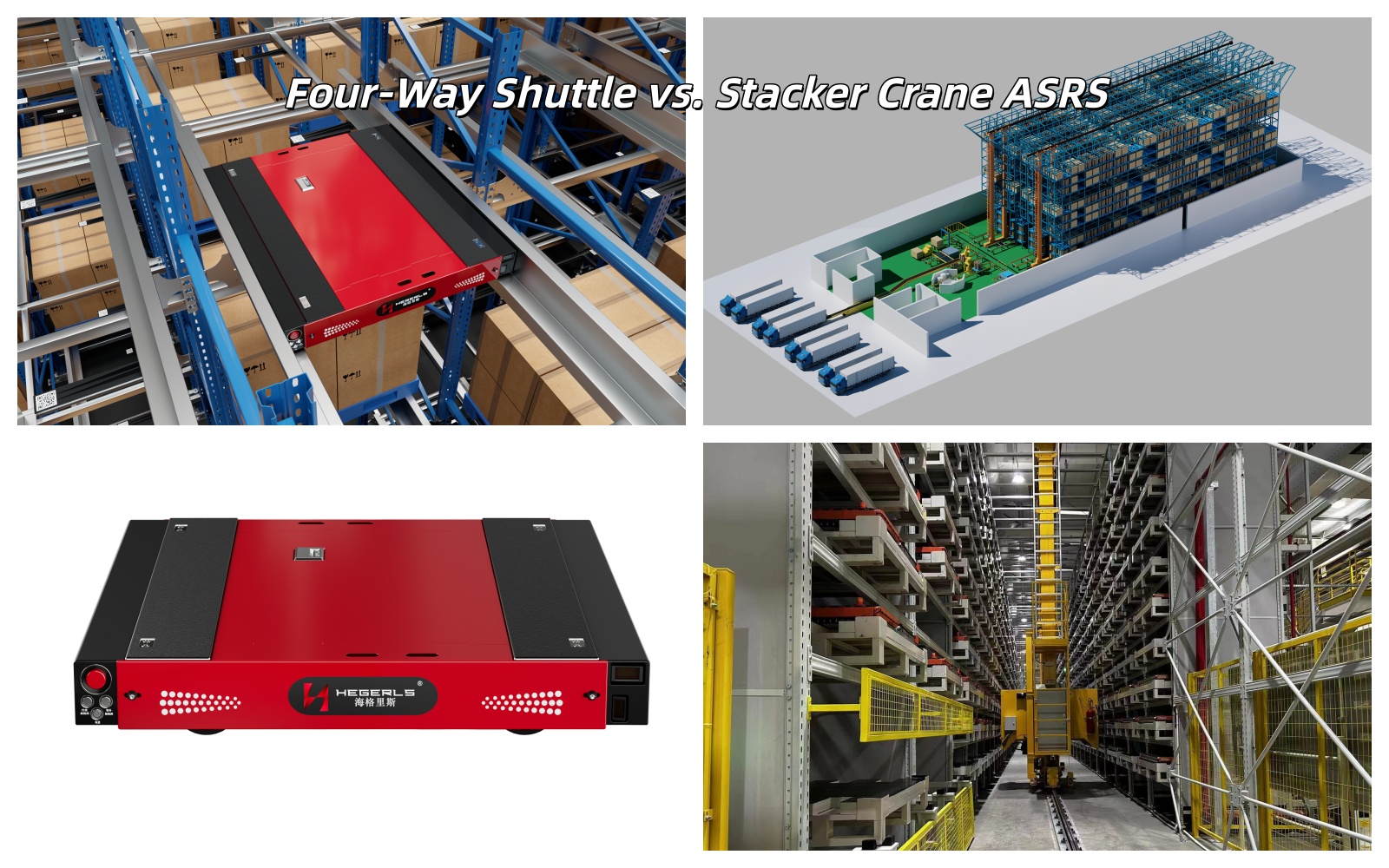
As warehouses become taller, denser, and more automated, companies increasingly compare four-way shuttle systems with stacker crane AS/RS when planning an automated pallet storage warehouse.
Both technologies can provide high-density storage, automated pallet handling, and integration with WMS and WCS. However, their mechanical structure, storage strategy, throughput characteristics, flexibility, and ideal applications are different.
Choosing between a four-way shuttle vs. stacker crane AS/RS should therefore be based on warehouse dimensions, pallet capacity, SKU profile, throughput, storage depth, flexibility, and long-term expansion requirements.
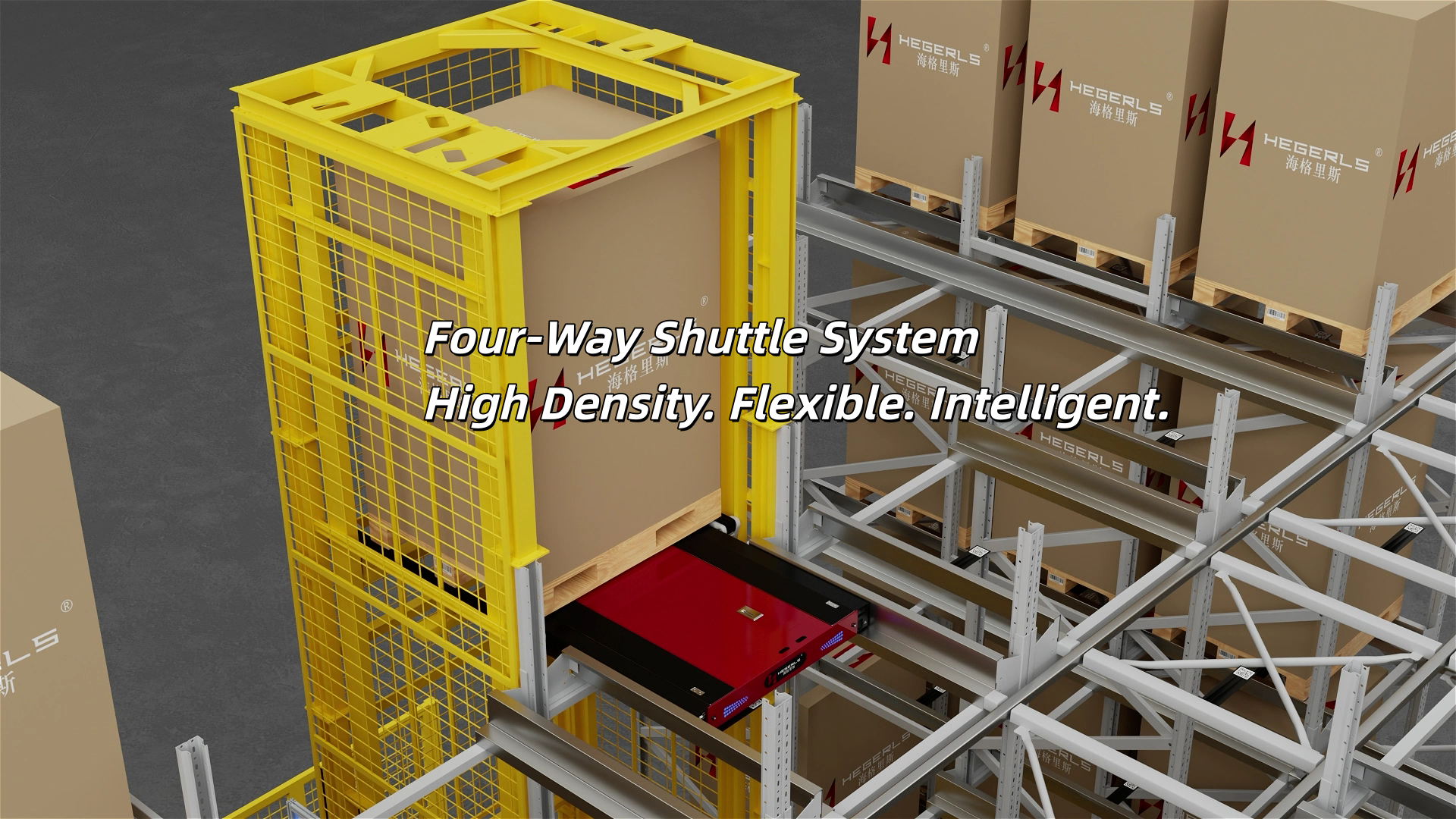
What Is a Four-Way Shuttle System?
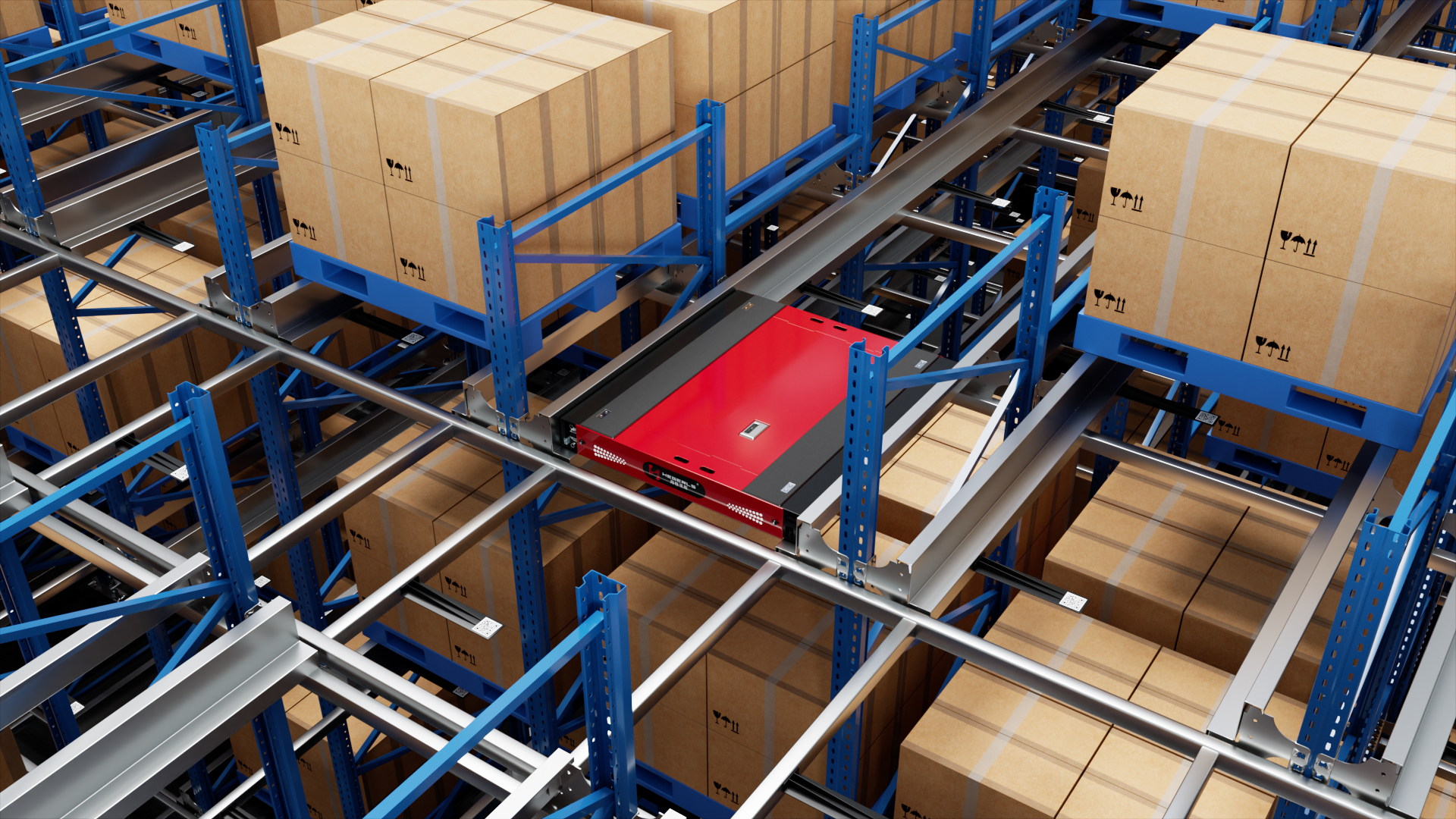
A four-way shuttle system is an automated pallet storage solution that uses shuttle vehicles capable of moving in multiple directions within a specially designed racking system.
Unlike conventional two-way shuttles, a four-way shuttle can travel:
- Forward
- Backward
- Left
- Right
This multi-directional movement allows the shuttle to transfer between storage lanes and provides greater flexibility in warehouse layout and pallet movement.
A typical four-way shuttle warehouse can include:
Four-Way Shuttle + Shuttle Lift + Storage Rack + Conveyor + CC-WMS + YUNTU-WCS
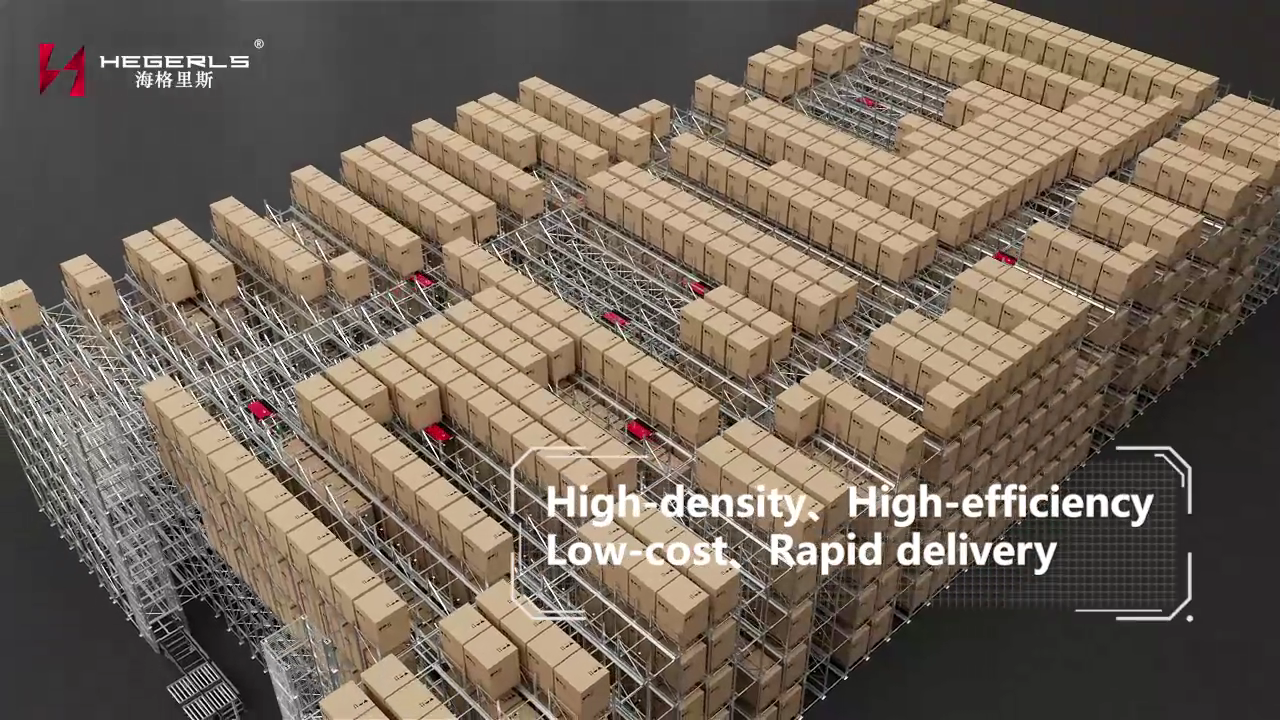
The system is particularly suitable for high-density storage, deep-lane pallet storage, automated warehouses, and flexible multi-zone storage.
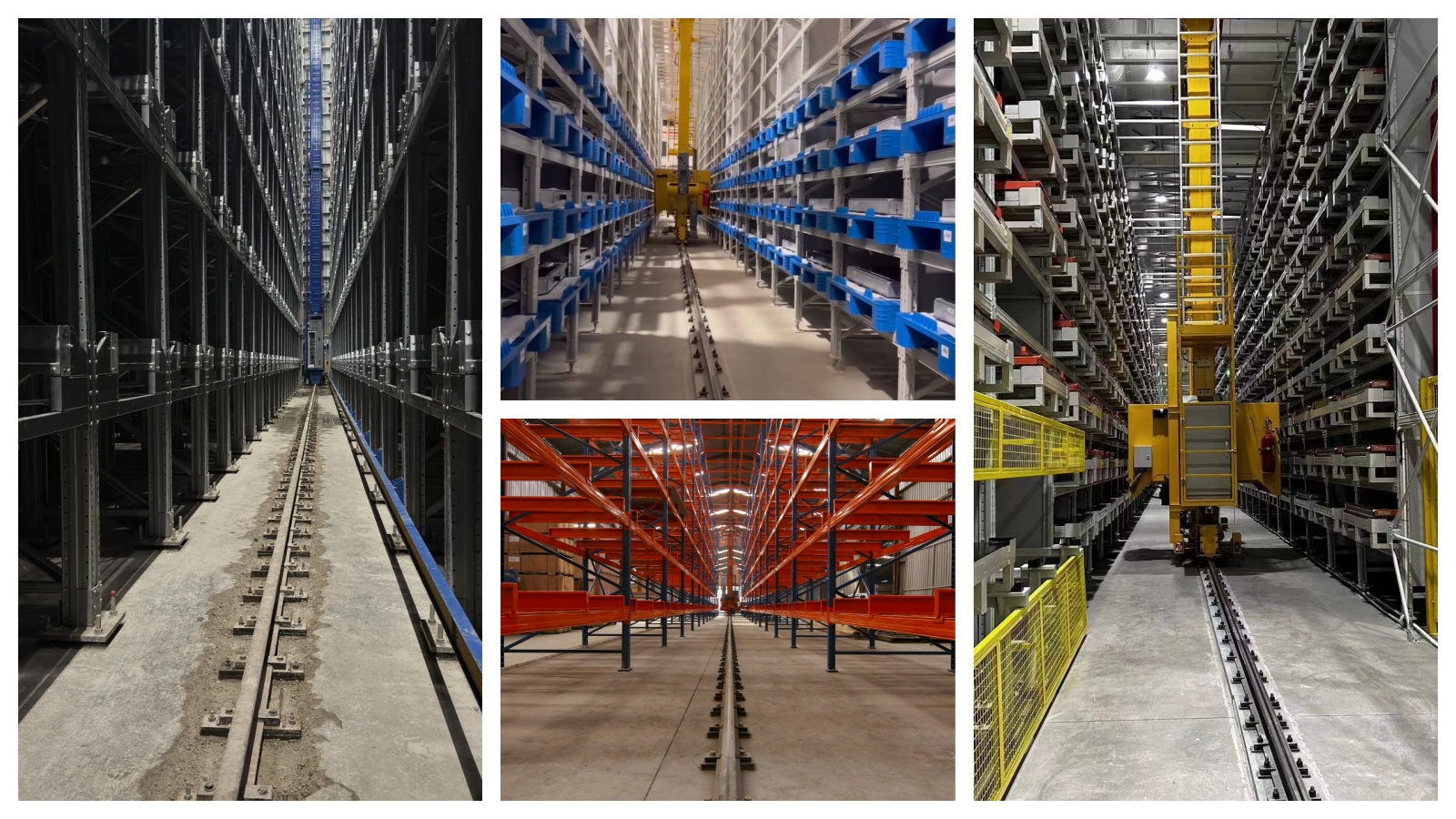
What Is a Stacker Crane AS/RS?
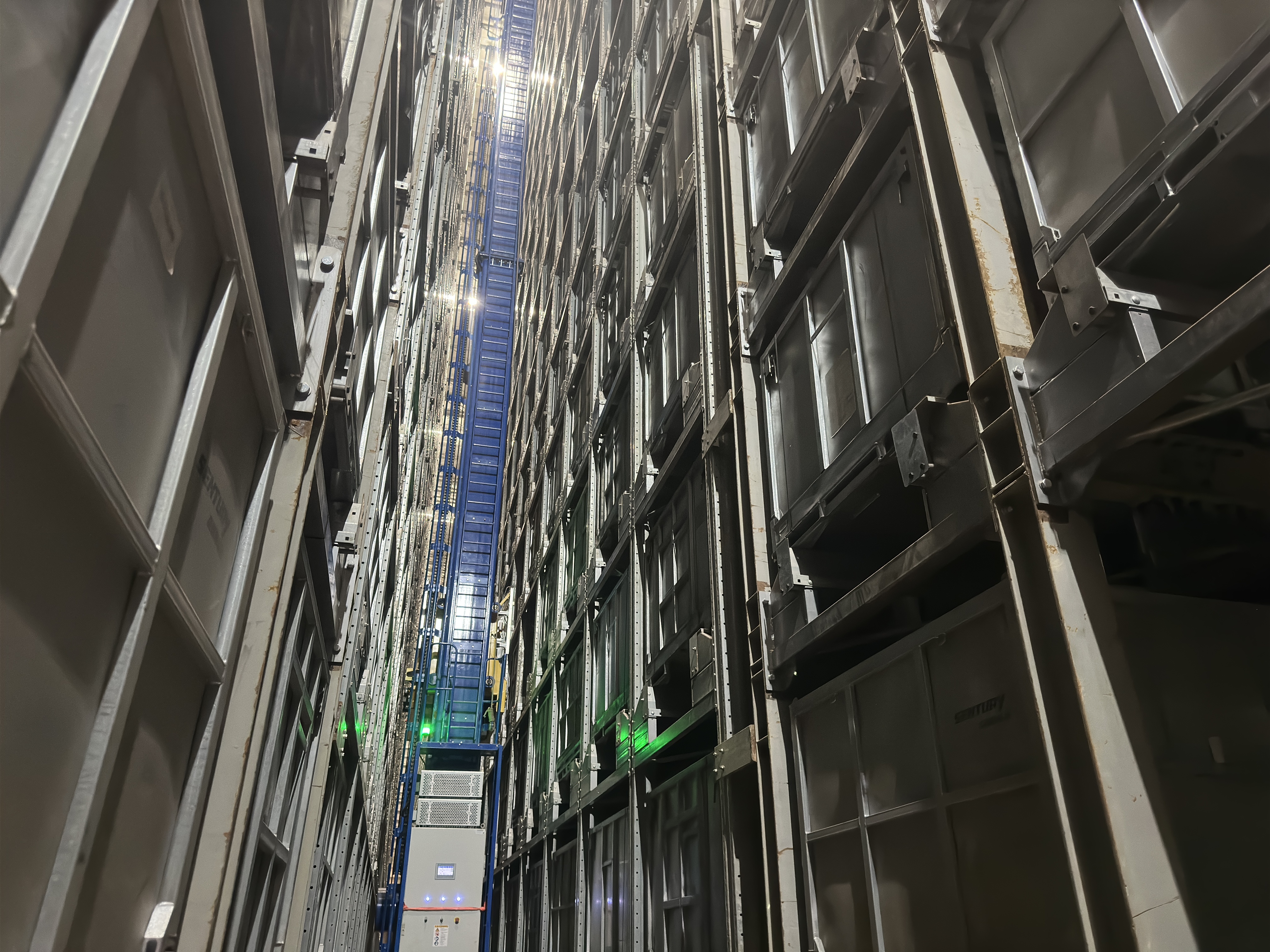
A stacker crane AS/RS, or automated storage and retrieval system, uses automated cranes to store and retrieve pallets from high-bay racking.
The stacker crane generally operates within a dedicated aisle, moving horizontally and vertically to access storage locations.
A typical pallet AS/RS includes:
- Stacker crane
- High-bay racking
- Pallet conveyors
- Lifts where required
- Pallet transfer equipment
- WMS
- WCS
- Safety systems
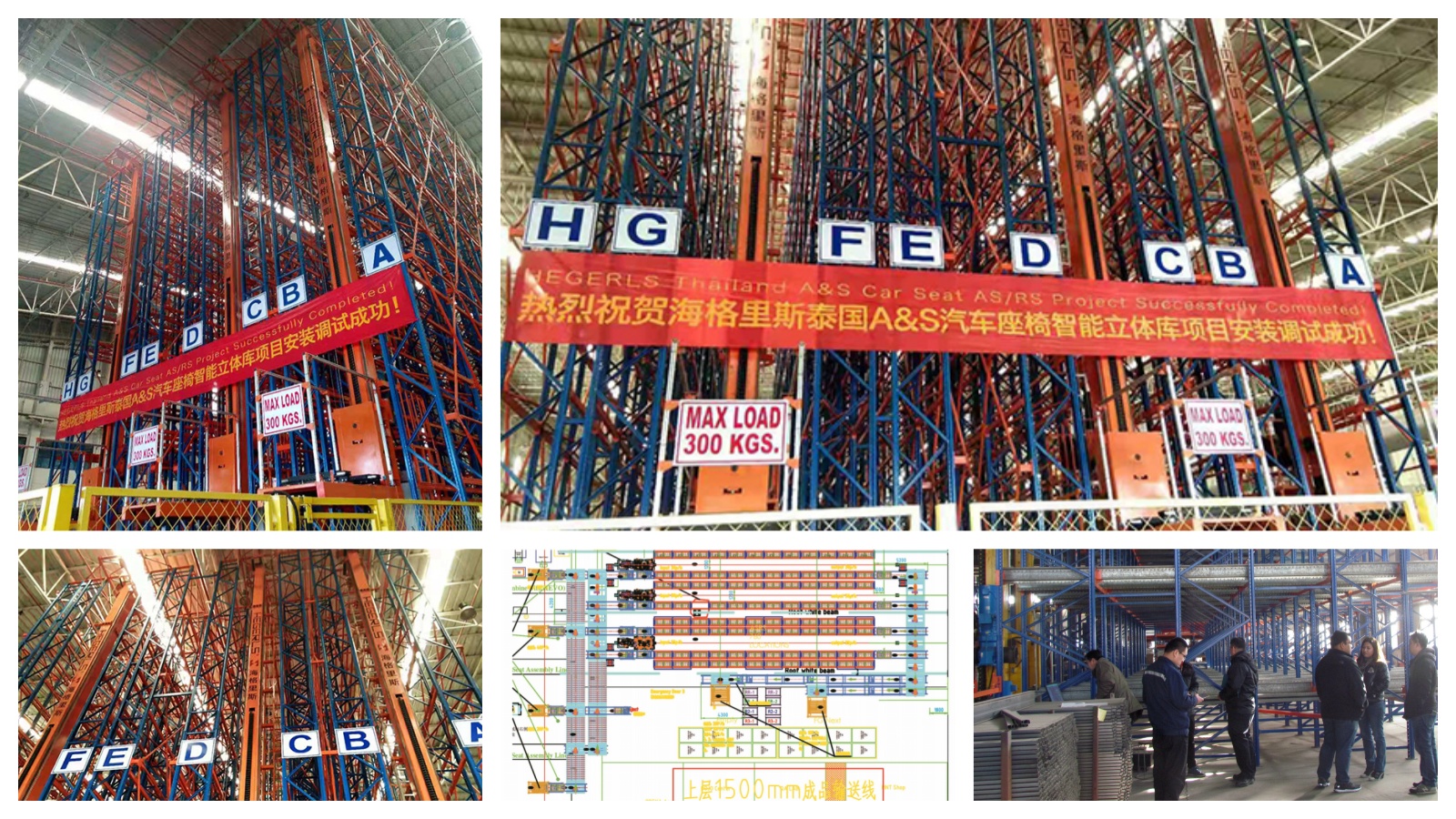
Because the crane can operate at significant heights, stacker crane AS/RS is widely used for high-bay automated warehouses with large storage capacities.
Four-Way Shuttle vs. Stacker Crane AS/RS: What Is the Difference?
The fundamental difference is the way each technology moves and accesses pallets.
A four-way shuttle system uses independent shuttle vehicles operating inside deep storage lanes, often supported by lifts for vertical movement.
A stacker crane AS/RS uses a crane that travels along a dedicated aisle and accesses pallet locations directly from the aisle.
| Factor | Four-Way Shuttle | Stacker Crane AS/RS |
| Storage principle | Deep-lane shuttle storage | Aisle-based automated storage |
| Horizontal movement | Multi-directional | Along dedicated aisle |
| Vertical movement | Usually via shuttle lift | Integrated crane mast |
| Storage density | Very high | Very high |
| Storage depth | Excellent for deep lanes | Generally more selective |
| Flexibility | Very high | High |
| Automation | High | Very high |
| Direct pallet access | Depends on configuration | High |
| Vertical capability | High | Excellent |
| Throughput | High | High to very high |
| Equipment redundancy | Relatively flexible | Depends on crane configuration |
| Layout flexibility | Excellent | More structured |
| Best application | Flexible high-density storage | High-bay automated storage |
Which System Provides Higher Storage Density?
Both systems can achieve very high storage density, but they achieve it differently.
Four-Way Shuttle
Four-way shuttles can store multiple pallets deep in a lane, significantly reducing the number of aisles required.
The system is especially effective when:
- Pallet quantities per SKU are high
- Deep-lane storage is acceptable
- Building space is limited
- High storage density is a priority
Stacker Crane AS/RS
Stacker crane systems make extensive use of vertical space and can support very tall rack configurations.
They are particularly suitable when:
- Warehouse height is high
- Individual pallet accessibility is important
- Large storage capacity is required
- High vertical utilization is a priority
Key Point
Four-way shuttle systems often have an advantage in deep-lane density, while stacker crane AS/RS can have an advantage in vertical high-bay utilization and direct location access.
Actual storage density depends on the complete warehouse design.
Which System Is More Flexible?
Four-Way Shuttle: High Flexibility
Four-way shuttles can move between lanes and directions, allowing more flexible storage layouts.
A warehouse can be divided into different storage zones according to:
- SKU
- Product category
- Temperature
- Batch
- Inventory turnover
- Customer
- Order priority
Additional shuttle vehicles can also potentially be introduced as demand increases, depending on the system design.
Stacker Crane AS/RS: Structured Flexibility
Stacker crane AS/RS is highly automated but normally follows a more structured aisle-based configuration.
Each crane is typically assigned to a specific aisle or group of storage locations.
This provides predictable operation and precise pallet handling, but major changes to the physical layout can be more difficult after installation.
Which System Is Better for High-Bay Warehouses?
Both systems can be used in high-bay warehouses.
However, stacker crane AS/RS is particularly well suited to very high storage structures because the crane integrates horizontal and vertical pallet movement.
Four-way shuttle systems can also support high warehouse heights when combined with shuttle lifts or other vertical transportation equipment.
The choice depends on:
- Building height
- Number of storage levels
- Required pallet positions
- Throughput
- Storage depth
- Equipment configuration
- Structural requirements
Which System Is Better for Deep-Lane Storage?
Four-way shuttle systems generally have a strong advantage for deep-lane storage.
A shuttle can transport pallets deep into the rack without requiring a forklift to enter the storage lane.
This allows the warehouse to reduce aisle requirements and increase the number of pallet positions within the available footprint.
Deep-lane four-way shuttle storage is particularly suitable for:
- Food & beverage
- Cold chain
- Manufacturing
- Chemical products
- Beverage storage
- Large quantities of similar products
Which System Provides Better Pallet Accessibility?
Stacker crane AS/RS generally provides more direct access to individual storage locations.
Because the crane works from an aisle and positions pallets at designated storage locations, individual pallet retrieval can be highly controlled.
Four-way shuttle systems are optimized for high-density storage, so pallet accessibility depends more heavily on:
- Lane depth
- SKU allocation
- Storage strategy
- Number of shuttles
- Lift configuration
- WCS task scheduling
If every pallet requires frequent individual access, an aisle-based AS/RS design may be more suitable.
If maximizing storage density is more important, deep-lane shuttle storage can be advantageous.
Four-Way Shuttle vs. Stacker Crane: Throughput Comparison
Throughput should be evaluated based on the complete system rather than a single piece of equipment.
Four-Way Shuttle Throughput
Throughput depends on:
- Number of shuttles
- Shuttle speed
- Lift quantity
- Conveyor capacity
- Charging strategy
- Storage depth
- WCS task scheduling
Multiple shuttles can operate simultaneously, allowing the system to scale horizontally.
Stacker Crane Throughput
Stacker crane throughput depends on:
- Crane speed
- Acceleration
- Number of cranes
- Storage height
- Travel distance
- Double-cycle operation
- Conveyor capacity
- WCS scheduling
Multiple cranes can be installed when higher throughput is required.
Important
Do not compare only the rated speed of a four-way shuttle and stacker crane.
A proper comparison should evaluate:
Pallets In/Hour + Pallets Out/Hour + Storage/Retrieval Cycles + Peak Demand
Which System Requires More Equipment?
The equipment architecture is different.
Four-Way Shuttle System
A typical system may include:
Shuttle + Lift + Rack + Conveyor + WMS + WCS
Depending on the warehouse configuration, multiple lifts and conveyors may be required.
Stacker Crane AS/RS
A typical system may include:
Stacker Crane + Rack + Conveyor + WMS + WCS
The crane itself combines horizontal and vertical movement.
Therefore, the number of equipment types alone should not be used to determine which system is simpler or more economical.
Which System Is More Flexible for Future Expansion?
Four-way shuttle systems can offer strong scalability because additional shuttle vehicles can potentially be introduced as warehouse demand increases.
A modular design may allow:
- Additional shuttles
- Additional lifts
- Additional storage lanes
- Additional conveyors
- Expanded WCS capacity
Stacker crane AS/RS can also be expanded, but expansion may require additional aisles, cranes, rack structures, conveyors, and associated infrastructure.
For businesses with uncertain future demand, modular four-way shuttle automation can be particularly attractive.
Four-Way Shuttle vs. Stacker Crane for Cold Storage
Both technologies can be used in cold storage.
However, high-density shuttle storage can be particularly attractive in cold and frozen warehouses because warehouse volume is expensive to build, cool, and maintain.
A four-way shuttle system can reduce aisle requirements and maximize storage density.
Stacker crane AS/RS can also maximize vertical space and provide automated pallet handling with minimal manual intervention.
The selection should consider:
- Temperature range
- Battery performance
- Equipment protection
- Storage density
- Pallet throughput
- Maintenance requirements
- Fire protection
- Refrigeration system
- Emergency access
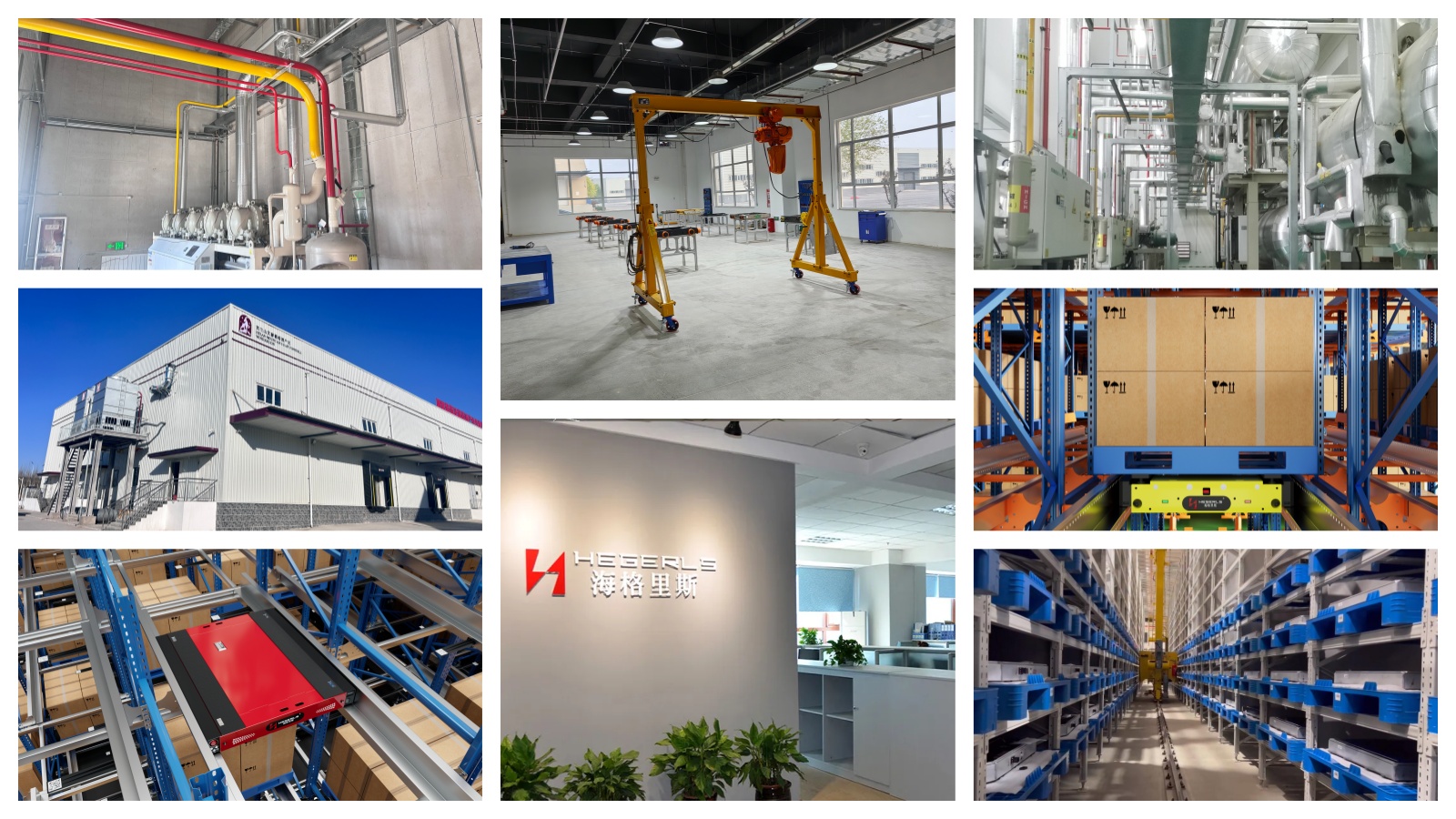
Four-Way Shuttle vs. Stacker Crane for Manufacturing
Manufacturing warehouses often require integration between raw-material storage, production, and finished-goods storage.
A stacker crane AS/RS can be effective when:
- High throughput is required
- Pallets need precise location management
- Production and warehouse systems require close integration
Four-way shuttles can be attractive when:
- Storage density is important
- Multiple product zones are required
- Flexible pallet movement is needed
- Inventory profiles change over time
Both systems can integrate with ERP, MES, WMS, and WCS.
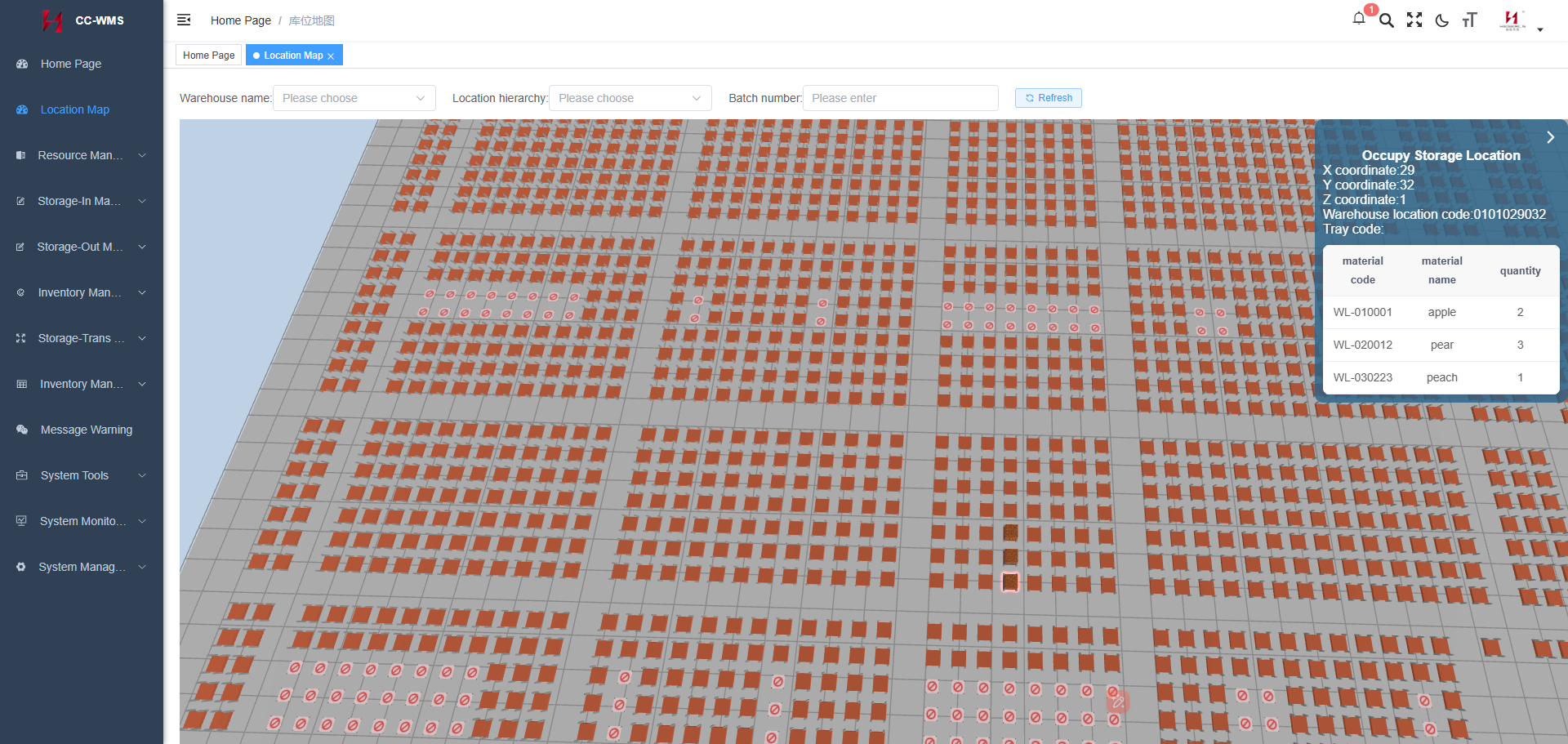
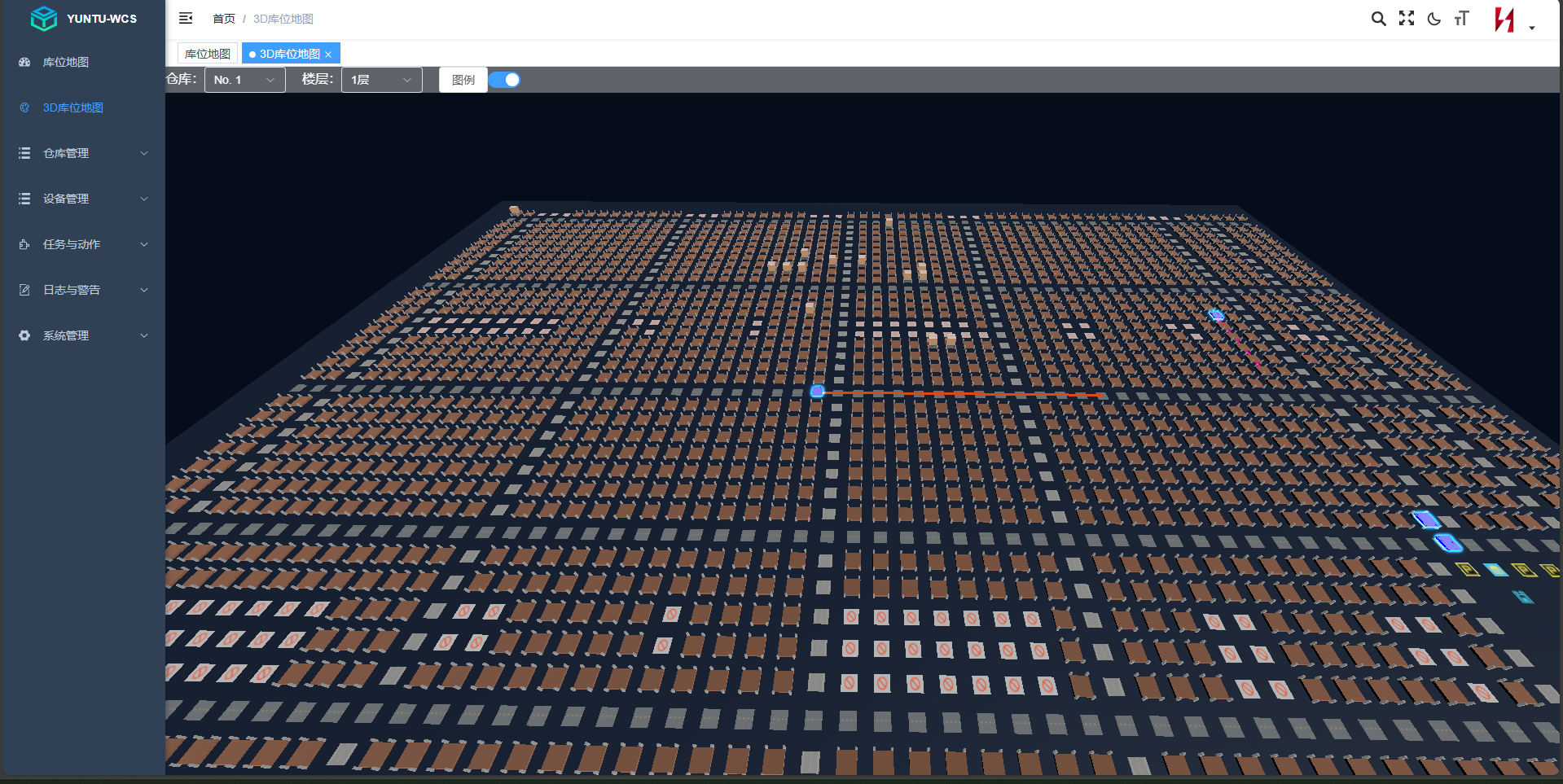
How Do WMS and WCS Affect the Choice?
Automation hardware is only one part of an automated warehouse.
The software layer determines how storage locations, inventory, equipment, and warehouse tasks are coordinated.
A typical architecture is:
ERP / MES
↓
CC-WMS
↓
YUNTU-WCS
↓
Four-Way Shuttle / Stacker Crane / Conveyor / Lift
↓
Warehouse Operations
CC-WMS
CC-WMS manages inventory and warehouse processes, including:
- Receiving
- Put-away
- Inventory management
- Location management
- Order management
- Picking
- Dispatch
- Inventory tracking
YUNTU-WCS
YUNTU-WCS manages equipment-level execution, including:
- Task allocation
- Equipment coordination
- Path planning
- Conveyor control
- Shuttle management
- Lift coordination
- Real-time equipment status
An intelligent WMS/WCS layer can significantly influence the actual performance of both four-way shuttle and stacker crane AS/RS systems.
 |  |
Four-Way Shuttle vs. Stacker Crane: Cost Considerations
The equipment purchase price should not be the only consideration.
Total project cost may include:
- Storage racks
- Shuttle vehicles or stacker cranes
- Lifts
- Conveyors
- Electrical systems
- WMS
- WCS
- Safety systems
- Building structure
- Installation
- Commissioning
- Maintenance
A four-way shuttle system may provide an attractive solution where deep storage density and modular scalability are important.
A stacker crane AS/RS may provide strong value where high vertical storage, precise pallet access, and high throughput are priorities.
The correct comparison is therefore based on total cost of ownership and operational performance, rather than equipment price alone.
Four-Way Shuttle or Stacker Crane: Which Should You Choose?
There is no universal answer. The right system should be selected according to the warehouse's operating requirements.
Choose a Four-Way Shuttle When:
- Storage density is a top priority
- Deep-lane storage is suitable
- Multiple pallets can be stored per SKU
- Layout flexibility is important
- Modular expansion is expected
- Cold storage space needs to be optimized
- Multiple storage zones are required
Choose Stacker Crane AS/RS When:
- Warehouse height is a major advantage
- Individual pallet accessibility is important
- High throughput is required
- Storage locations need precise control
- The warehouse has a structured layout
- Large-scale automation is planned
- Production and warehouse processes require close integration
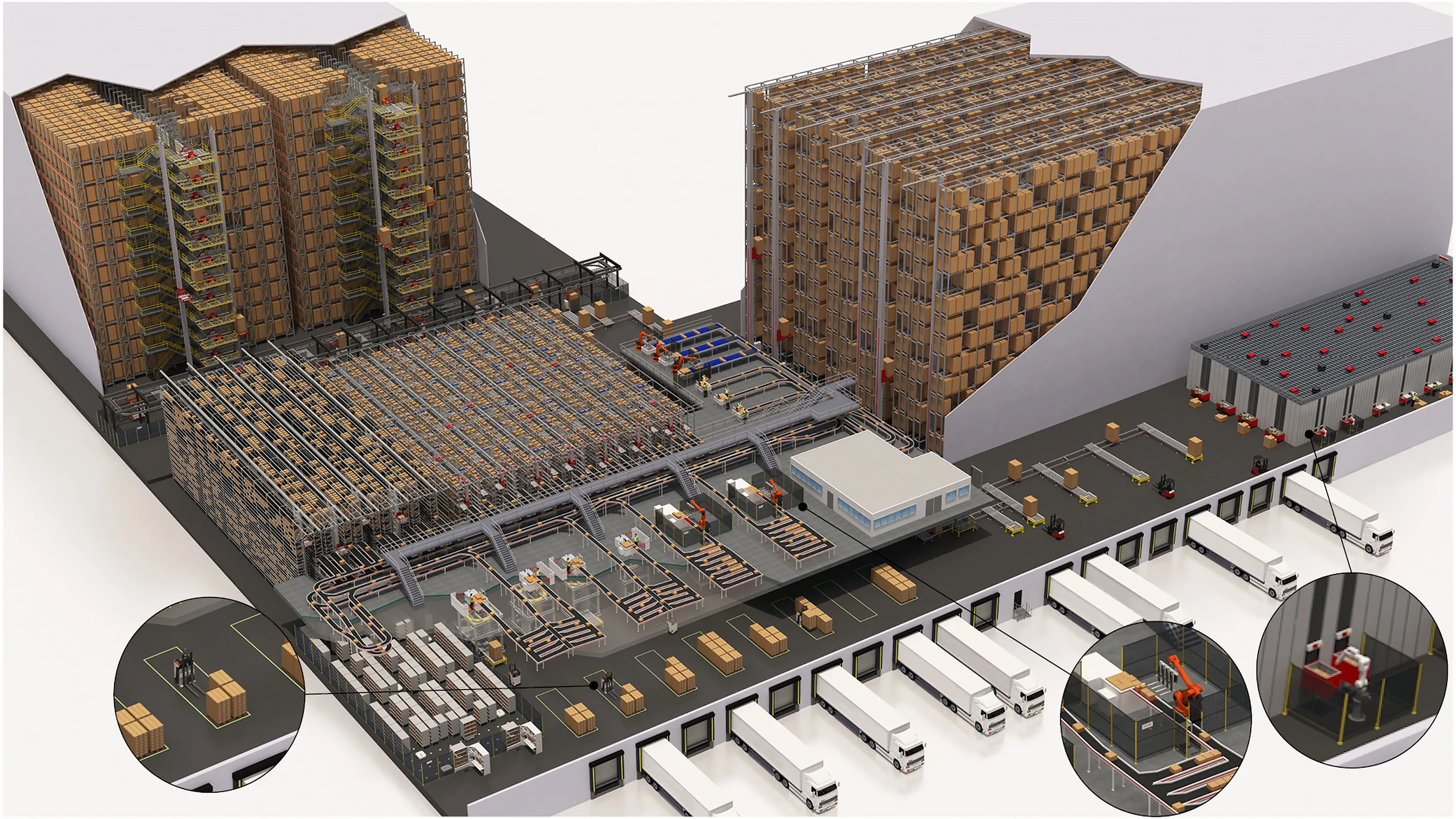
Consider a Hybrid Solution When:
Some warehouses do not need to choose only one technology.
A hybrid automated warehouse can combine:
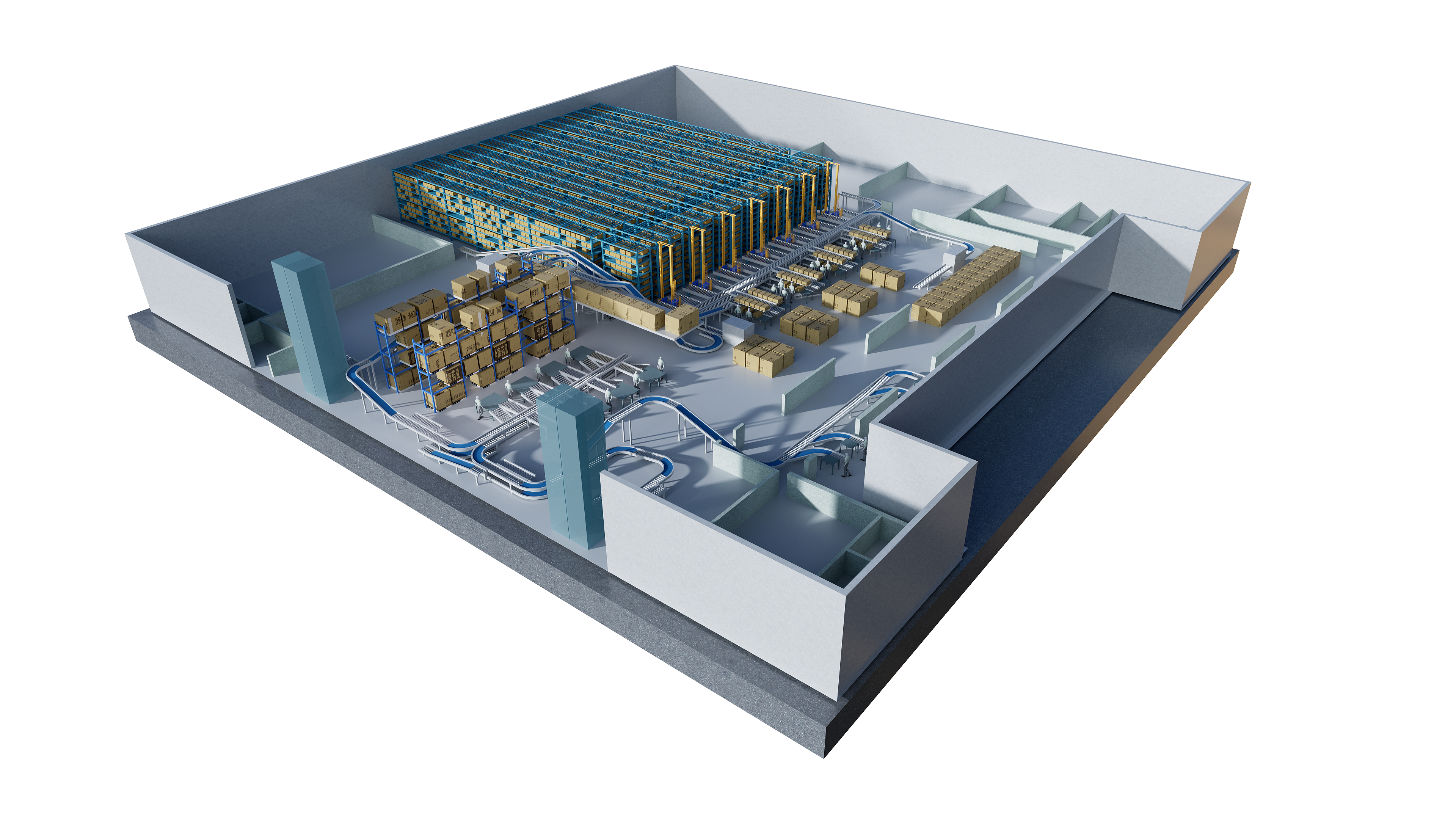
Stacker Crane AS/RS + Four-Way Shuttle + Conveyor + WMS + WCS
For example, stacker cranes can handle high-bay or fast-moving storage zones, while four-way shuttles handle high-density buffer storage.
This approach can provide greater flexibility when warehouse requirements vary significantly between product categories or operational zones.
What Factors Should Be Evaluated Before Making a Decision?
Before selecting a four-way shuttle or stacker crane AS/RS, evaluate:
- Warehouse dimensions
- Clear height
- Pallet dimensions
- Pallet weight
- Number of SKUs
- Pallet quantity
- Storage depth
- Required throughput
- Inventory rotation
- Required pallet accessibility
- Temperature conditions
- Future expansion
- Building structure
- WMS/WCS requirements
- Total cost of ownership
This information allows an automation supplier to calculate the appropriate rack configuration, equipment quantity, storage capacity, and material flow.
Why Choose Zhuku for Automated Storage Solutions?
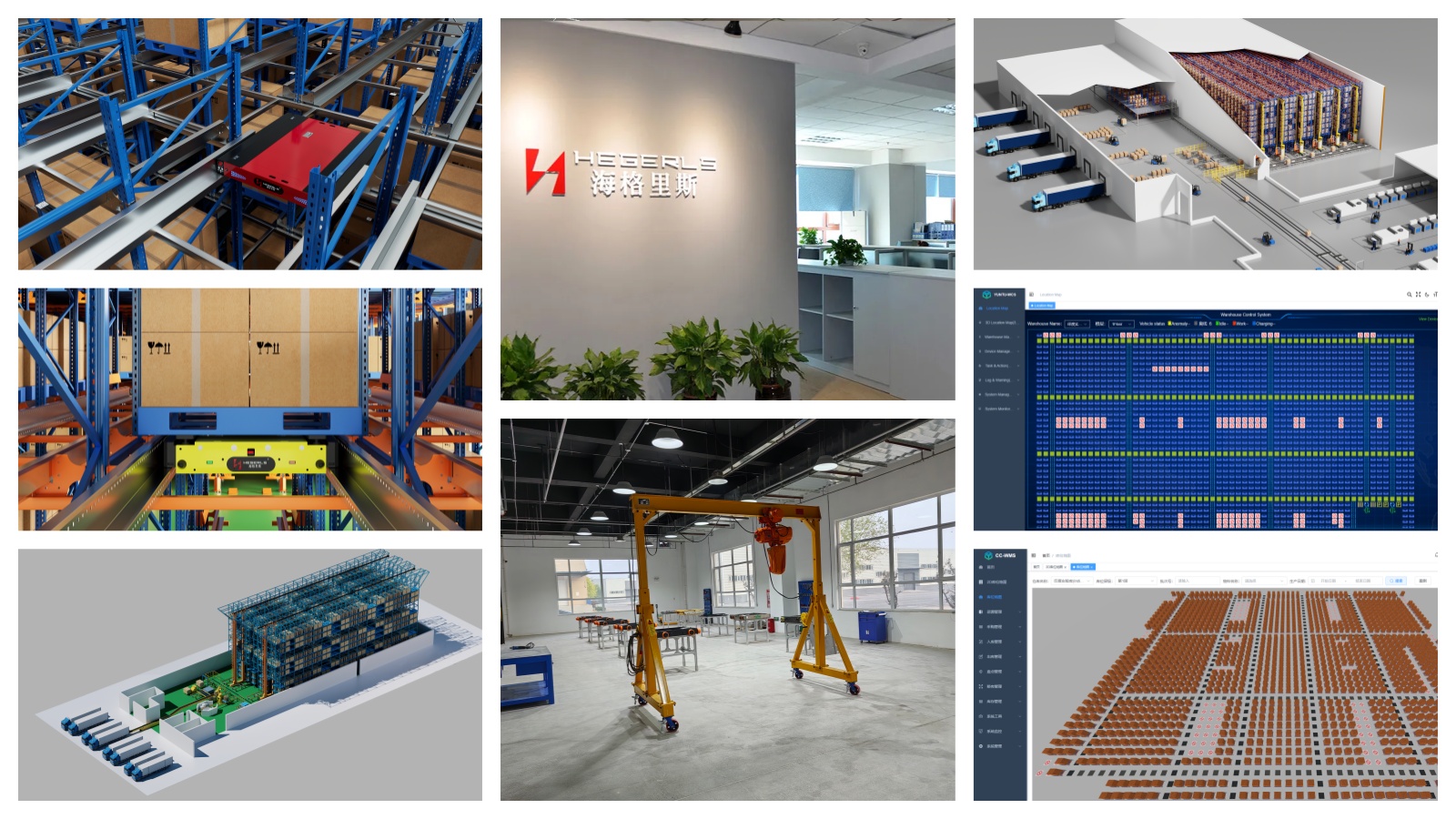
Zhuku provides integrated four-way shuttle systems, stacker crane AS/RS, high-density storage, rack-supported warehouses, conveyors, WMS, and WCS.
Our engineering approach considers the entire warehouse system rather than evaluating individual equipment separately.
Solutions can be designed around:
- Warehouse dimensions
- Storage capacity
- Pallet specifications
- SKU profile
- Throughput
- Temperature
- Automation requirements
- Future expansion
Zhuku can integrate four-way shuttles or stacker cranes with CC-WMS and YUNTU-WCS to create automated storage and retrieval solutions for manufacturing, logistics, food and beverage, cold chain, and other industries.
Conclusion
The choice between a four-way shuttle vs. stacker crane AS/RS ultimately depends on the warehouse's operational priorities.
A four-way shuttle system is particularly suitable when the primary objectives are high-density storage, deep-lane utilization, flexible movement, and scalable automation.
A stacker crane AS/RS is particularly suitable when the warehouse requires high vertical utilization, direct pallet access, precise automated storage and retrieval, and high throughput.
For large or complex warehouses, a hybrid architecture may provide the best result.
The right solution is not necessarily the system with the fastest equipment or the highest theoretical storage density. It is the system that provides the best overall balance of:
Storage Density + Throughput + Accessibility + Flexibility + Automation + Cost + Scalability
Which Automated Storage System Is Right for Your Warehouse?
Share your warehouse dimensions, pallet size, storage capacity, SKU quantity, and inbound/outbound throughput with Zhuku. Our team can evaluate whether a four-way shuttle system, stacker crane AS/RS, or hybrid automated storage solution is the better fit for your project.