Material handling equipment plays an essential role in warehouses, manufacturing facilities, distribution centers, and logistics operations. From moving pallets with forklifts to automatically storing and retrieving goods with AS/RS, these machines and systems help businesses move, store, protect, and control materials throughout their operations.
Choosing the right equipment can improve material flow, reduce manual handling, increase storage efficiency, and support safer working conditions. However, different operations require different solutions. A small warehouse with frequent manual picking has different needs from a high-throughput distribution center or an automated manufacturing facility.
This guide explains the main types of material handling equipment, provides practical warehouse examples, and outlines the key factors to consider when selecting equipment.
1. What Is Material Handling Equipment?
Material handling equipment refers to the machines, devices, and systems used to move, store, position, protect, and control materials during manufacturing, warehousing, distribution, and transportation.
It covers a wide range of equipment, including forklifts, pallet trucks, conveyors, cranes, storage racks, automated guided vehicles (AGVs), autonomous mobile robots (AMRs), and automated storage and retrieval systems (AS/RS).
In a warehouse, material handling equipment supports several basic operations:
-
Receiving: Unloading goods from trucks and transferring them into the facility.
-
Moving: Transporting materials between receiving, storage, picking, and shipping areas.
-
Storing: Placing goods in designated storage locations and making them accessible when needed.
-
Retrieving: Removing goods from storage for order fulfillment or production.
-
Sorting and positioning: Organizing materials and positioning them for subsequent operations.
-
Shipping: Moving finished orders to staging areas and loading them onto vehicles.
These activities form the foundation of warehouse material flow. The equipment used depends on the type of goods, handling frequency, facility layout, and required level of automation.
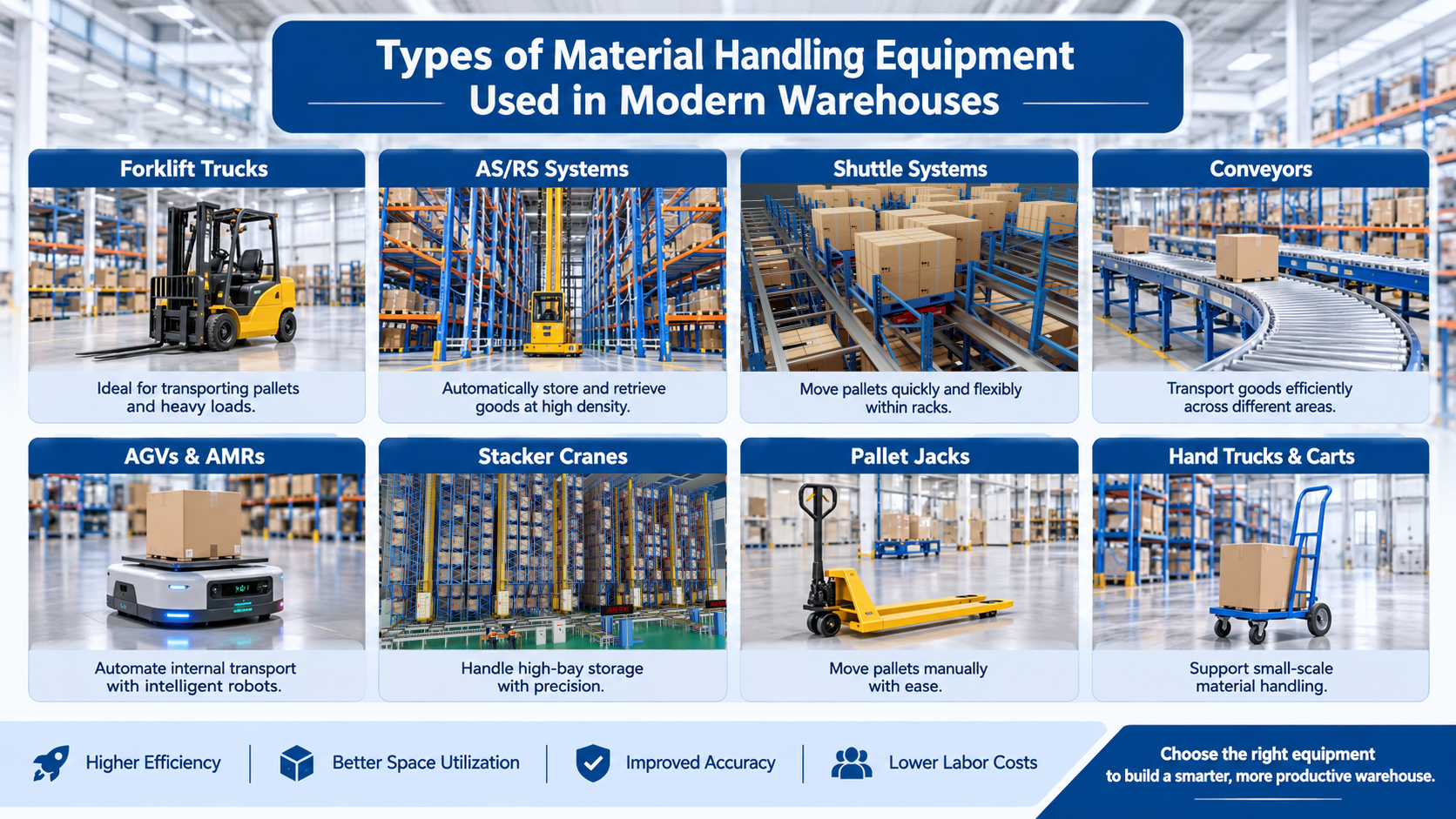
2. What Are the Main Types of Material Handling Equipment?
Material handling equipment can be classified according to its primary function. The main categories include transport equipment, storage and retrieval equipment, positioning equipment, unit load formation equipment, and bulk material handling equipment.
2.1 Transport Equipment
Transport equipment moves materials from one location to another, either manually, mechanically, or automatically.
Common examples include:
-
Forklifts: Used to lift, stack, and transport palletized loads.
-
Pallet trucks: Move pallets over short distances, particularly in loading, unloading, and picking areas.
-
Tow tractors: Pull multiple carts or trailers along established routes.
-
Conveyors: Transport cartons, pallets, and other materials continuously between workstations.
-
AGVs: Follow programmed routes or navigation systems to transport materials automatically.
-
AMRs: Use sensors and navigation technology to move through changing environments and perform transport tasks.
The choice depends on travel distance, load weight, traffic conditions, and transportation frequency. Forklifts are versatile for different warehouse tasks, while conveyors and mobile robots are useful when material movement follows frequent or repetitive workflows.
2.2 Storage and Retrieval Equipment
Storage and retrieval equipment helps businesses use available warehouse space efficiently while maintaining access to inventory.
Typical examples include:
-
Pallet racking: Provides structured storage locations for palletized goods.
-
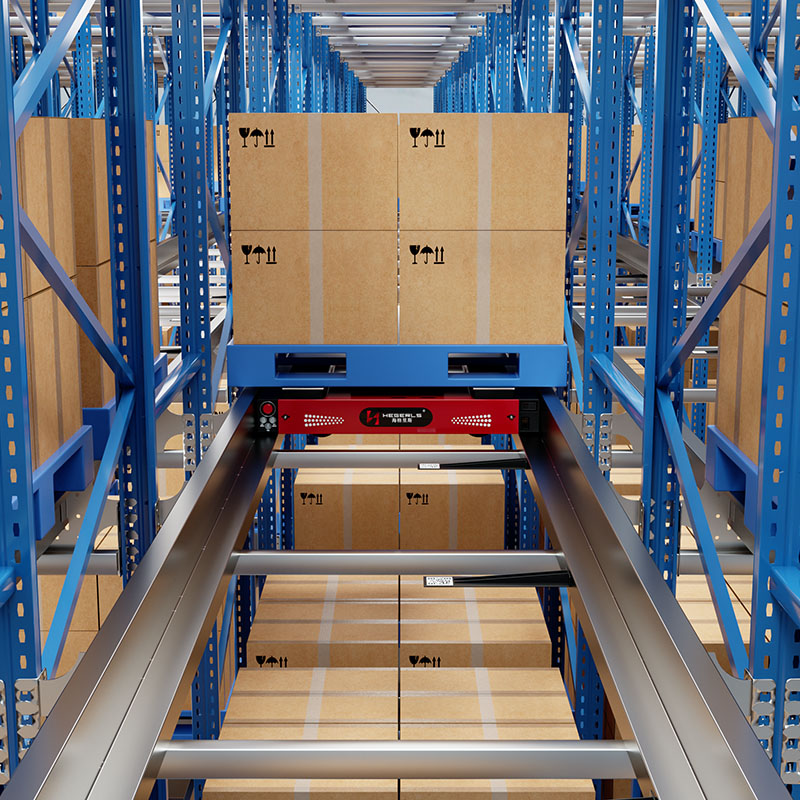
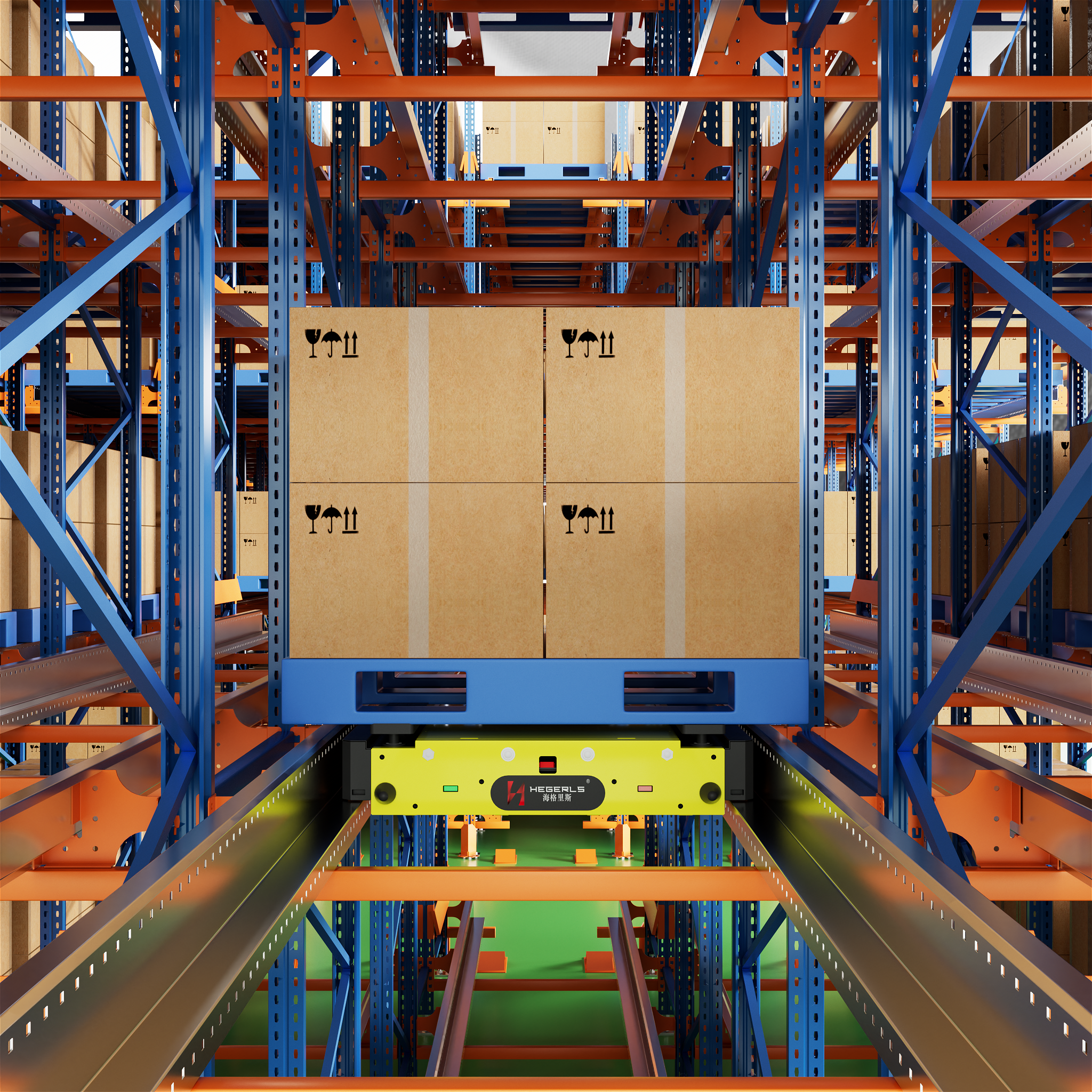
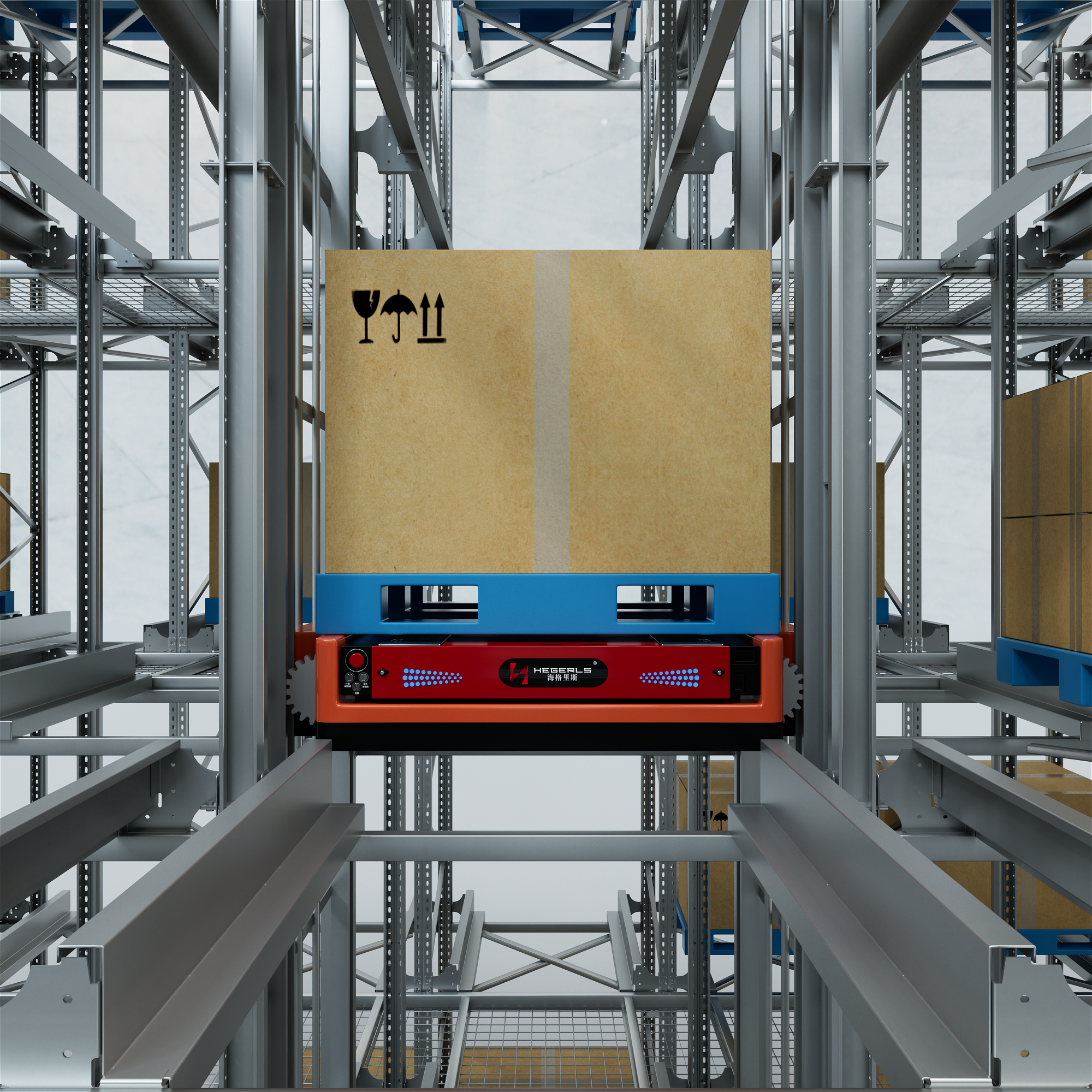
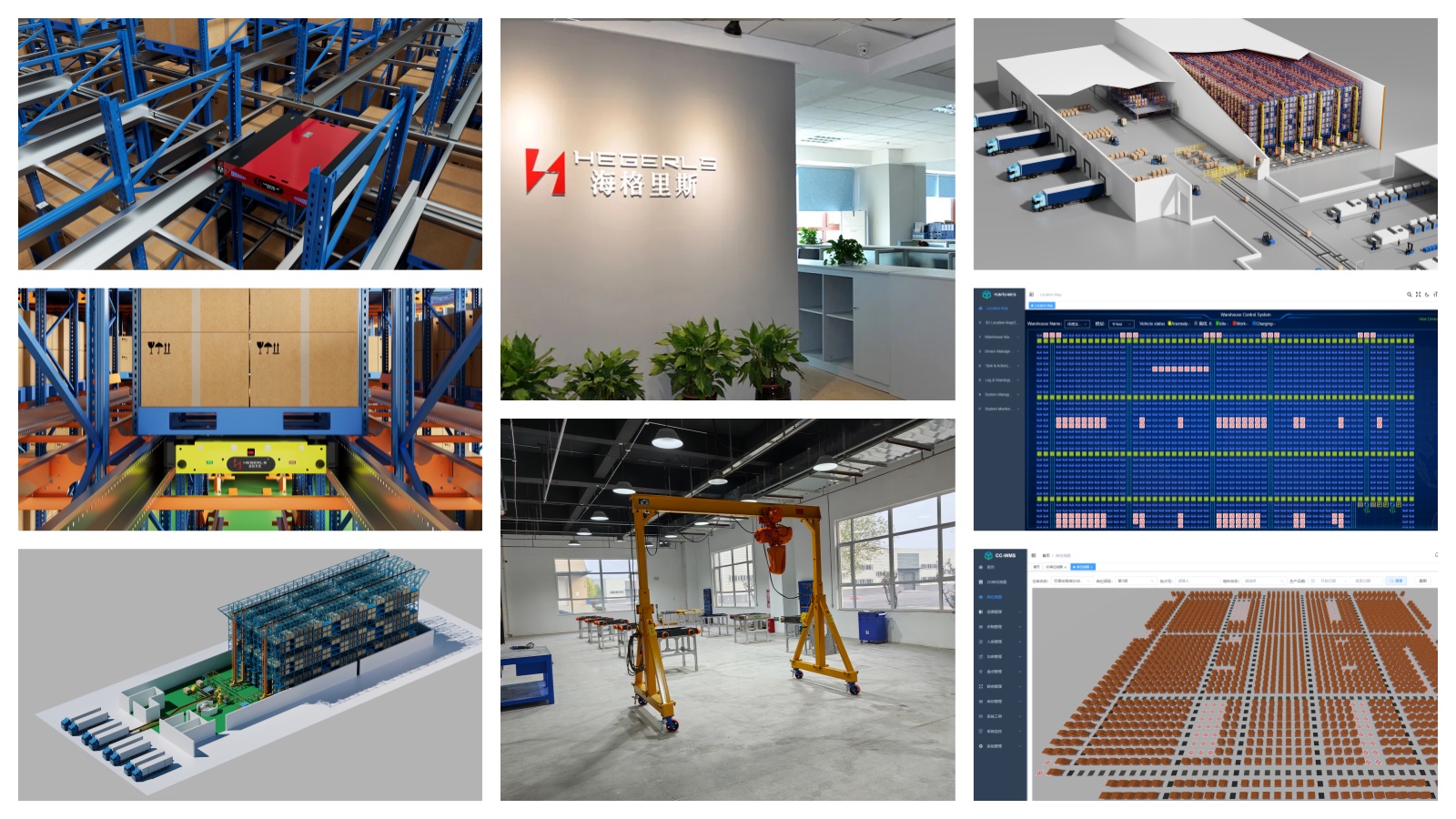
Automated Storage and Retrieval Systems (AS/RS): Automatically store and retrieve materials using equipment such as stacker cranes or shuttle systems.
-
Stacker cranes: Travel along storage aisles to handle loads at different rack levels.
-
Shuttle systems: Use powered shuttle vehicles to move pallets or other loads within storage lanes.
-
Mobile racking: Moves storage racks to create access aisles when required.
-
Vertical lift modules: Store and retrieve smaller items using vertically arranged trays.
The appropriate storage and retrieval solution depends on warehouse height, SKU characteristics, inventory turnover, storage density, and throughput requirements.
For example, a conventional pallet racking system may suit a warehouse with moderate storage density and frequent forklift access. A shuttle-based AS/RS may be more suitable when a facility needs higher-density pallet storage and automated handling.
2.3 Positioning Equipment
Positioning equipment moves or adjusts materials to the height, orientation, or position required for the next operation.
Common types include:
-
Lift tables: Raise or lower loads to suitable working heights.
-
Hoists: Lift heavy materials vertically.
-
Industrial manipulators: Assist operators in handling heavy or awkward objects.
-
Positioning platforms: Adjust the position of materials during assembly or processing.
-
Balancers: Support suspended tools or loads to reduce operator effort.
These handling machines are commonly used in manufacturing, assembly, packaging, and maintenance operations.
2.4 Unit Load Formation Equipment
Unit load formation equipment combines individual products or packages into larger, manageable loads. This makes transportation, storage, and shipping more efficient.
Examples include:
-
Pallets and pallet containers
-
Storage bins and totes
-
Palletizers and depalletizers
-
Stretch wrapping machines
-
Strapping machines
Palletizers, for example, arrange products into stable pallet loads for storage or transportation. Stretch wrapping and strapping equipment help secure goods during handling and shipment.
2.5 Bulk Material Handling Equipment
Bulk material handling equipment is designed for materials that are transported in large quantities without individual packaging, such as powders, grains, aggregates, and granules.
Typical equipment includes:
-
Belt conveyors
-
Screw conveyors
-
Bucket elevators
-
Hoppers
-
Vibrating feeders
These systems are widely used in agriculture, food processing, mining, chemical production, and other industrial applications.
Unlike equipment designed for individual pallets or cartons, bulk material handling machinery focuses on continuous or controlled movement of loose materials.
3. Material Handling Equipment Examples in Warehouses
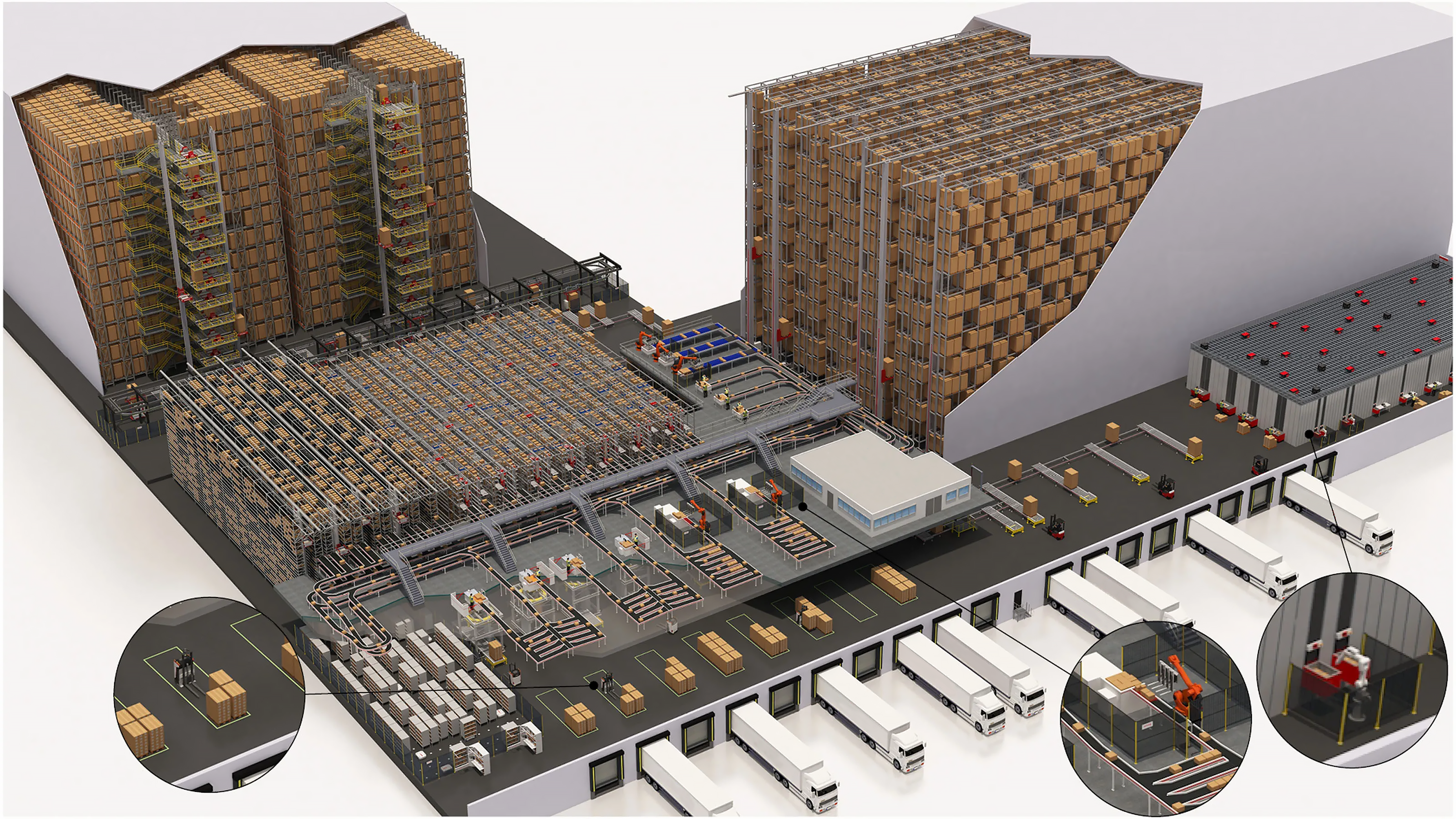
Warehouses often use several types of material handling equipment together. Each piece of equipment performs a specific task within the overall material flow.
| Equipment | Main Function | Typical Warehouse Application |
| Forklift | Lifting and transporting palletized goods | Loading, unloading, and pallet storage |
| Pallet truck | Moving pallets over short distances | Receiving and picking areas |
| Conveyor | Continuous material movement | Sorting and order fulfillment |
| Pallet racking | Storing palletized goods | Inventory storage |
| Stacker crane | Automated storage and retrieval | High-bay warehouses |
| Four-way shuttle | Moving pallets within rack systems | High-density automated storage |
| AGV | Automated material transportation | Repetitive internal transport |
| AMR | Flexible mobile material movement | Dynamic warehouse workflows |
| Lift table | Adjusting load height | Packing and workstation operations |
How Do These Equipment Types Work Together?
Consider a warehouse receiving palletized goods from delivery trucks.
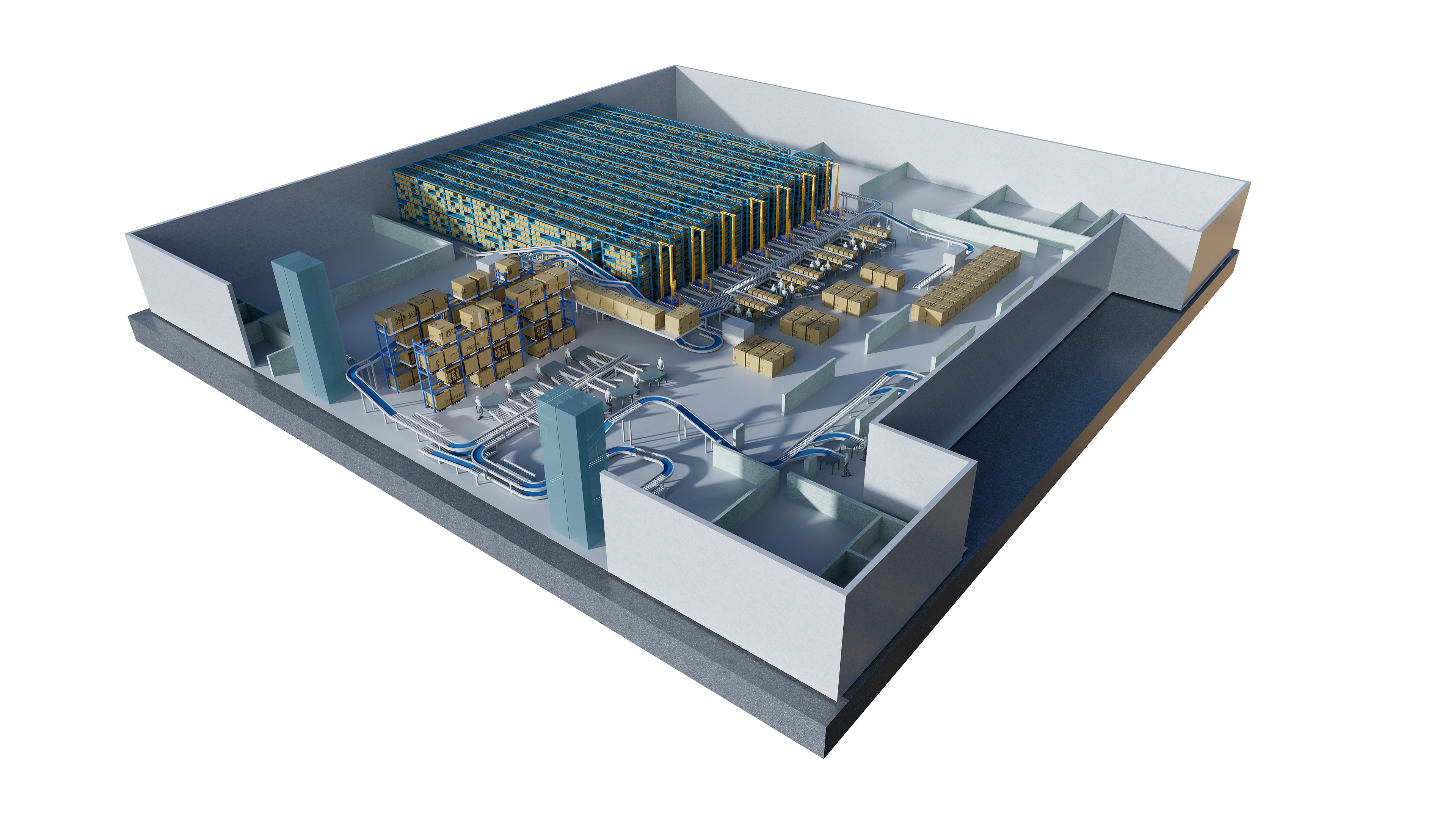
First, forklifts or pallet trucks unload the goods and transfer them to the receiving area. Conveyors or other transport equipment may then move the pallets toward inspection or storage. Once the goods are ready, forklifts, stacker cranes, or shuttle systems transfer them into designated storage locations.
When an order is released, the warehouse management system identifies the required inventory. Storage and retrieval equipment brings the goods to the appropriate picking or dispatch area. Finally, conveyors and other handling equipment move completed orders to the loading zone.
This workflow illustrates why material handling equipment should be planned as a connected system rather than selected as a collection of independent machines.
4. Manual, Mechanical, Semi-automated and Automated Material Handling Equipment
Another way to classify material handling equipment is by its level of automation.
4.1 Manual Material Handling Equipment
Manual equipment relies primarily on operators to move or position materials.
Examples include:
-
Hand pallet trucks
-
Platform carts
-
Hand trolleys
-
Manual stackers
-
Hand-operated lifting devices
These tools are relatively straightforward and can be suitable for small warehouses, workshops, and operations with low handling volumes.
However, manual handling becomes less practical when loads are heavy, travel distances are long, or handling tasks are repeated frequently.
4.2 Mechanical Material Handling Equipment
Mechanical equipment uses powered or mechanical systems to reduce manual effort.
Examples include:
-
Electric forklifts
-
Electric pallet trucks
-
Hoists and cranes
-
Powered conveyors
-
Mechanical lifting systems
These machines can handle heavier loads and support higher handling frequencies than basic manual equipment. Operators are still generally required to control or supervise the equipment.
4.3 Semi-automated and Automated Material Handling Equipment
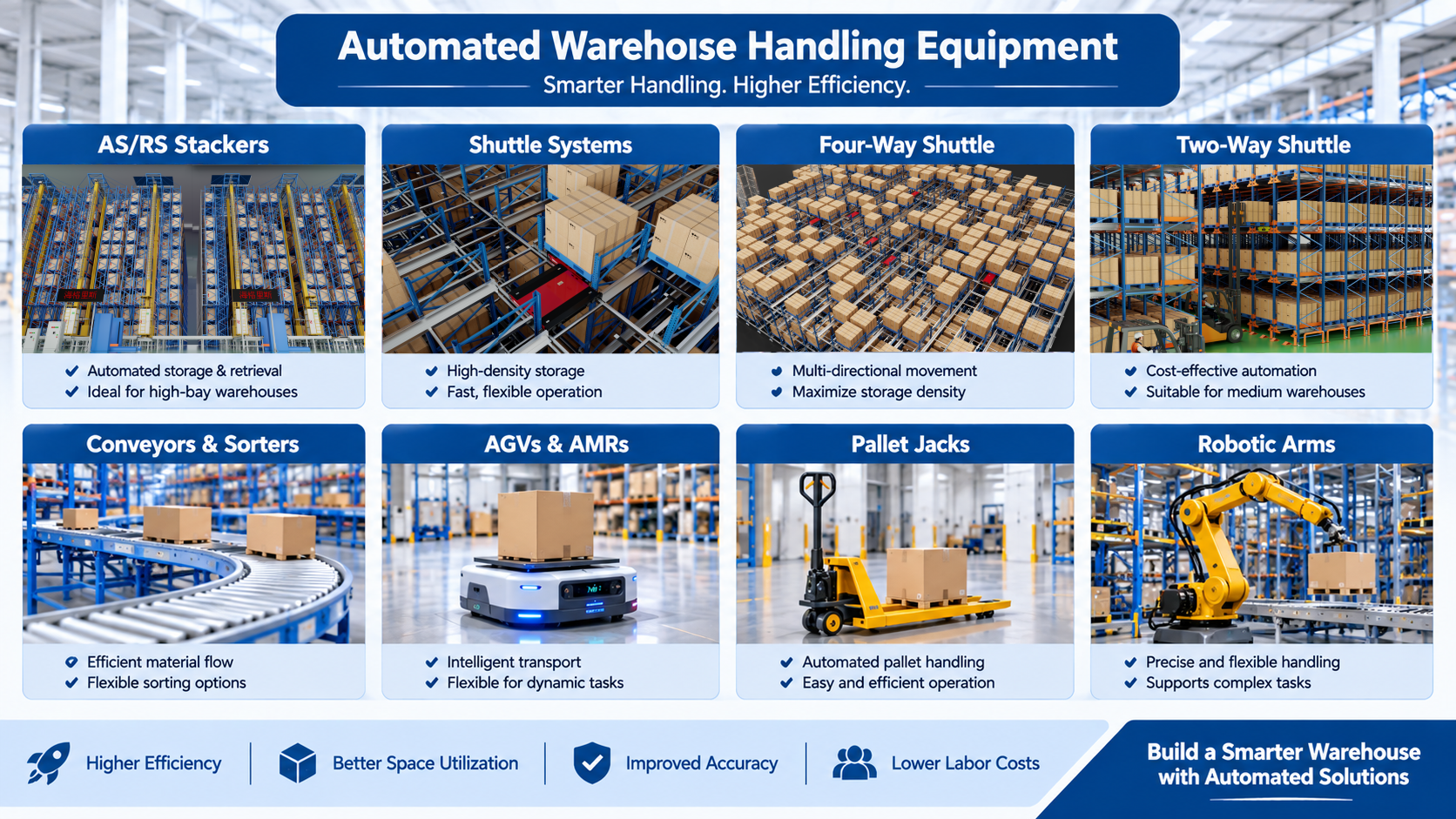
Semi-automated and automated material handling equipment performs transportation, storage, retrieval, sorting, or other tasks with reduced manual intervention.
Common examples include:
-
Automated Storage and Retrieval Systems (AS/RS)
-
Automated Guided Vehicles (AGVs)
-
Autonomous Mobile Robots (AMRs)
-
Automated conveyor and sorting systems
-
Shuttle-based storage systems
-
Automated pallet handling systems
Automated systems are particularly useful for operations that require consistent material flow, high storage density, frequent handling, or integration with warehouse management software.
Automation does not necessarily mean removing every manual task. Many warehouses combine automated equipment with forklifts, manual picking stations, and operator-controlled processes.
5. How to Choose the Right Material Handling Equipment
Selecting the right material handling equipment requires an understanding of the entire operation, not just the load capacity or purchase price of an individual machine.
5.1 Consider Material Characteristics
Start by evaluating the materials that need to be handled.
Important factors include:
-
Load weight and dimensions
-
Product shape and packaging
-
Whether goods are palletized, boxed, or stored in containers
-
Fragility and handling restrictions
-
Temperature, humidity, and environmental requirements
For example, palletized goods may be handled using forklifts, pallet conveyors, or AS/RS. Small components may require bins, totes, picking systems, or specialized storage equipment.
5.2 Evaluate Warehouse Layout and Storage Requirements
The warehouse layout directly affects equipment selection.
Consider:
-
Available floor space and building height
-
Aisle width and turning space
-
Storage rack configuration
-
Inbound and outbound locations
-
Travel distances between operating areas
-
Existing building and floor conditions
A warehouse with limited floor space may benefit from higher-density storage solutions. A high-bay facility may require stacker cranes or shuttle-based AS/RS to access elevated storage locations safely and efficiently.
5.3 Match Equipment to Throughput Requirements
Throughput refers to the volume of materials that a warehouse or production facility can handle within a specific period.
A warehouse with low daily movement may operate effectively with forklifts and pallet trucks. A distribution center with frequent order processing may need conveyors, automated sorting equipment, and automated storage systems.
Before selecting equipment, estimate:
-
Daily inbound and outbound volumes
-
Peak-hour handling requirements
-
Number of storage and retrieval operations
-
Order lines and picking frequency
-
Required response time between operations
The goal is to avoid both insufficient capacity and unnecessary investment in oversized equipment.
5.4 Evaluate Safety and Automation Requirements
Material handling equipment must match the facility's safety requirements and operating conditions.
Consider load stability, pedestrian traffic, equipment speed, operator training, emergency stops, and maintenance access.
For automated equipment, also evaluate navigation, obstacle detection, traffic coordination, system monitoring, and communication with warehouse software.
5.5 Compare Total Cost of Ownership
The initial purchase price is only one part of equipment investment.
A more complete evaluation should include:
-
Equipment purchase and installation
-
Infrastructure modifications
-
Software and system integration
-
Energy consumption
-
Maintenance and spare parts
-
Operator training
-
Downtime and replacement costs
-
Future expansion requirements
A solution with a higher initial cost may offer better long-term value if it improves storage utilization, reduces repetitive labor, or supports higher throughput.
6. Material Handling Equipment Parts, Supplies, and Supporting Systems
A complete material handling operation depends on more than the main machines. Equipment components, handling supplies, and control software also contribute to reliable operation.
6.1 Common Material Handling Equipment Parts
Different machines have different components, but frequently used parts include:
-
Motors and drive units
-
Wheels and rollers
-
Forks and attachments
-
Batteries and charging systems
-
Sensors and safety devices
-
Control panels and electrical components
-
Bearings, chains, and belts
Regular inspection and preventive maintenance help identify wear, reduce unexpected downtime, and maintain equipment performance. Replacement parts should match the equipment manufacturer's specifications.
6.2 Material Handling Supplies
Material handling supplies are the supporting items used to package, organize, protect, and transport goods.
Examples include:
-
Wooden or plastic pallets
-
Storage bins and totes
-
Containers
-
Protective packaging
-
Stretch film and strapping materials
-
Labels and identification tags
These supplies are not necessarily material handling machinery, but they directly affect load stability, storage compatibility, and handling efficiency.
6.3 Software and Control Systems
As warehouse operations become more automated, software plays an increasingly important role in coordinating equipment and inventory.
A typical architecture may include:
-
Warehouse Management System (WMS): Manages inventory, storage locations, receiving, picking, and order processing.
-
Warehouse Control System (WCS): Coordinates equipment tasks, movement sequences, and operational workflows.
-
Fleet Management System: Manages the tasks, routes, and operating status of AGVs or AMRs.
-
Equipment Monitoring Systems: Track equipment conditions, alarms, and maintenance requirements.
In an integrated warehouse, the WMS system determines what needs to be stored or retrieved, while the WCS system coordinates the equipment responsible for carrying out those tasks.
For more information, explore CC-WMS Warehouse Management System and YUNTU-WCS Warehouse Control System.
7. Material Handling Equipment Across Different Industries
Material handling requirements vary according to the products, production processes, and operating environments of each industry.
| Industry | Common Equipment | Main Requirements |
| Warehousing and distribution | Forklifts, conveyors, racking, AS/RS, shuttles | Storage efficiency and inventory flow |
| Manufacturing | Cranes, conveyors, AGVs, manipulators | Production line material supply |
| Food and beverage | Conveyors, pallet handling systems, cold storage equipment | Hygiene and temperature control |
| Automotive | Assembly conveyors, lifting equipment, AGVs | Component delivery and production coordination |
| Pharmaceutical | Automated storage, bins, conveyors | Traceability and controlled handling |
| E-commerce and retail | Sorters, conveyors, AMRs, picking systems | High-volume order fulfillment |
| Cold chain logistics | Cold-rated forklifts, shuttle systems, AS/RS | Low-temperature operation and storage density |
In cold storage facilities, for example, equipment must be suitable for the operating temperature and environmental conditions. In e-commerce distribution centers, the priority may be rapid order processing and flexible material movement.
The most effective solution is therefore determined by the actual workflow rather than the industry label alone.
8. How to Choose a Material Handling Equipment Supplier
Choosing a material handling equipment supplier is an important part of warehouse planning. Buyers should evaluate not only the equipment itself but also the supplier's ability to support the complete project.
Key considerations include:
1. Product and technical range
Check whether the supplier can provide equipment that matches the required load types, storage conditions, and handling processes.
2. Engineering and customization capabilities
Warehouse layouts and material flows vary. A capable supplier should be able to evaluate site conditions and recommend suitable equipment configurations.
3. System integration experience
For automated projects, equipment must work with warehouse software, conveyors, control systems, and other logistics technologies.
4. Project references
Review relevant project experience, especially projects with similar storage requirements, operating environments, and throughput targets.
5. Safety and quality management
Check applicable product standards, safety features, quality management processes, and relevant certifications.
6. Installation and after-sales support
Consider commissioning, operator training, maintenance services, spare parts availability, and technical support.
For complex warehouse projects, it is also worth evaluating whether the supplier can provide an integrated solution instead of simply supplying individual machines.
Conclusion: Building an Efficient Material Handling System
Material handling equipment is essential to the movement, storage, and control of goods across warehouses and industrial facilities. From basic pallet trucks and forklifts to conveyors, shuttle systems, and AS/RS, each equipment type serves a different operational purpose.
The right selection depends on material characteristics, warehouse layout, throughput, safety requirements, and automation objectives. For operations with complex storage and transportation needs, combining suitable handling equipment with warehouse management and control systems can create a more coordinated material flow.
Zhuku provides warehouse automation and storage solutions, including four-way shuttle systems, stacker crane systems, and warehouse software integration. If you are planning a new warehouse or upgrading an existing facility, share your warehouse layout, load specifications, and expected throughput with our team to explore a suitable solution.