Warehouse equipment plays a vital role in keeping modern storage and distribution operations organized, safe, and efficient. From pallet racking and forklifts to automated storage and retrieval systems (AS/RS), different types of equipment support the movement, storage, picking, and transportation of goods.
As warehouse operations become more complex, businesses need to consider more than individual machines. The right combination of storage equipment, material handling systems, and automation technologies can improve space utilization, reduce unnecessary handling, and support higher operational efficiency.
This guide explores the main types of warehouse equipment, their applications, common examples, and the factors to consider when selecting equipment for a warehouse.
1. What Is Warehouse Equipment?
Warehouse equipment refers to the machines, structures, tools, and systems used to support daily warehouse operations. These include equipment for storing inventory, moving goods, lifting loads, picking orders, sorting products, and preparing shipments.
Common warehouse equipment includes:
-
Storage racks and shelving systems
-
Forklifts and pallet trucks
-
Conveyors and lifting equipment
-
Automated storage and retrieval systems
-
Order picking and sorting equipment
-
Loading dock and packaging equipment
The specific equipment required depends on warehouse size, product characteristics, inventory volume, throughput requirements, and the level of automation.
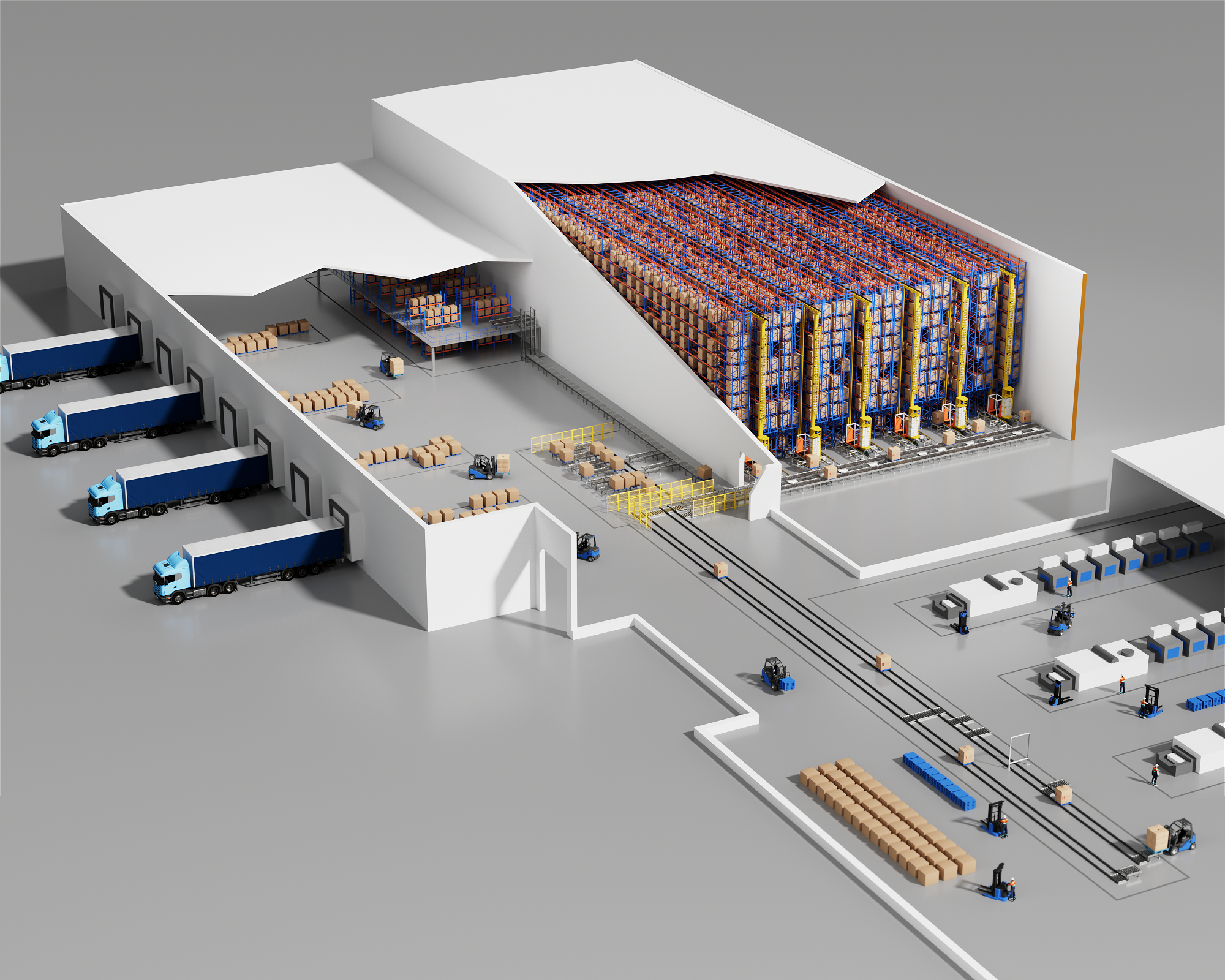
In a traditional warehouse, forklifts, pallet trucks, and conventional racking may handle most daily tasks. In a highly automated facility, stacker cranes, shuttle systems, conveyors, and warehouse control software can coordinate storage and material movement with less manual intervention.
2. What Are the Main Types of Warehouse Equipment?
Warehouse equipment can be classified according to the tasks it performs. The main categories include storage equipment, material handling equipment, lifting equipment, loading and unloading equipment, picking and sorting equipment, and packaging equipment.
2.1 Warehouse Storage Equipment
Storage equipment provides designated locations for inventory and helps businesses make better use of available warehouse space.
Common types include:
Pallet racking is widely used to store palletized goods. Different configurations support different storage and accessibility requirements.
Examples include:
-
Selective pallet racking
-
Drive-in and drive-through racking
-
Double-deep racking
-
Mobile racking
Shelving Systems
Warehouse shelving is commonly used for smaller products, cartons, tools, and components that require manual access.
Automated Storage and Retrieval Systems (AS/RS)
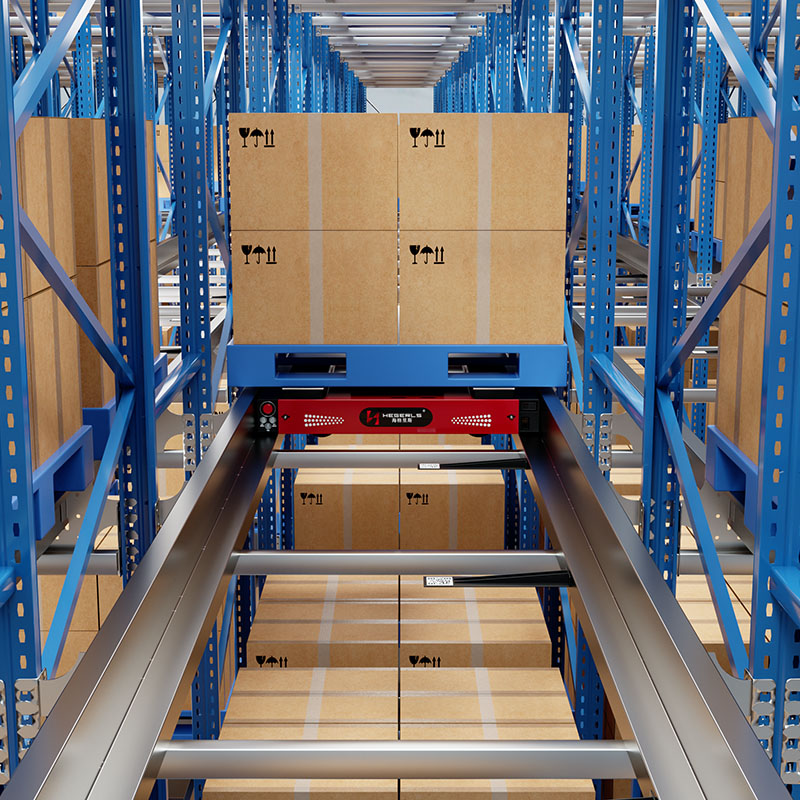
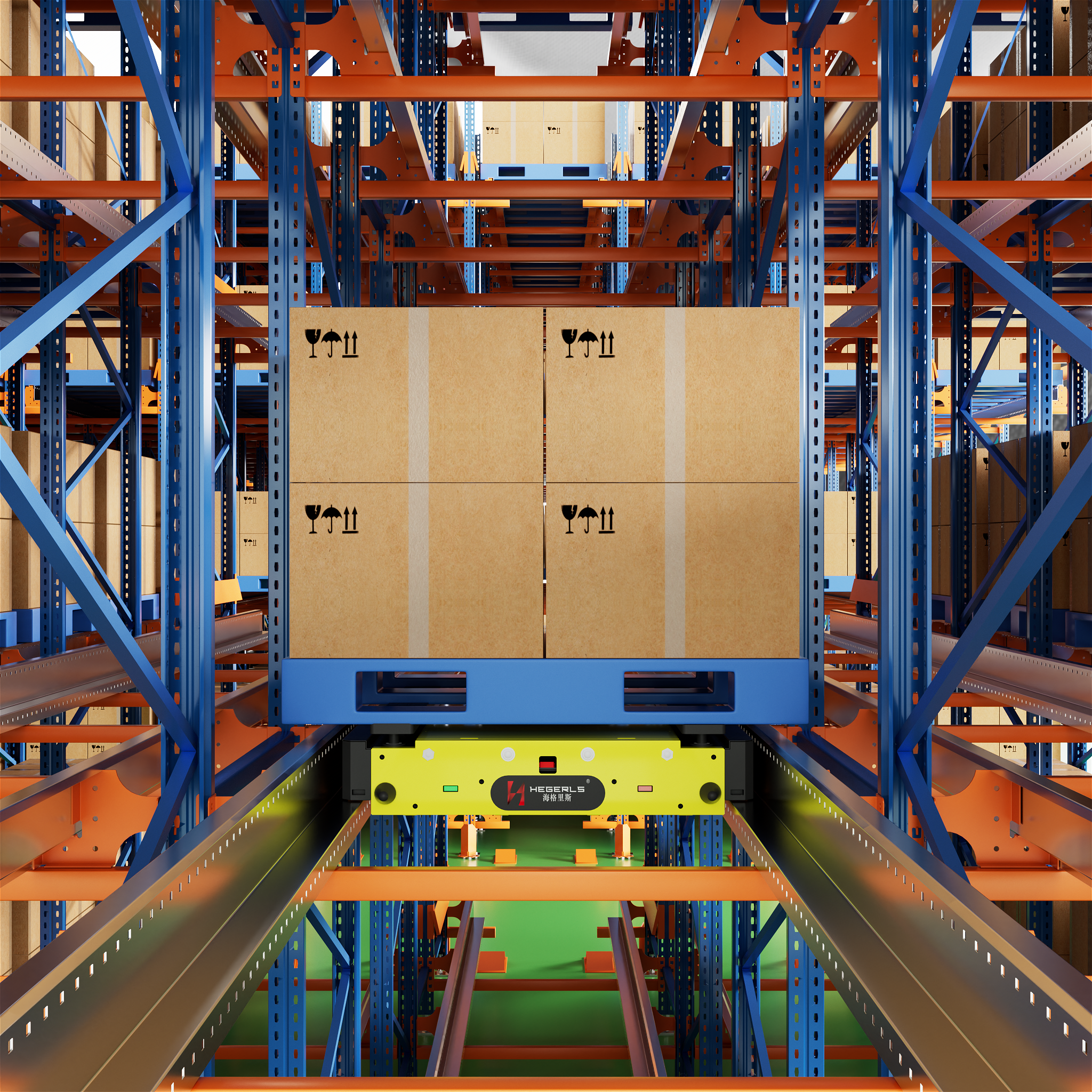
AS/RS uses automated equipment to store and retrieve goods from designated storage locations. Depending on the load type and warehouse design, systems may use stacker cranes, shuttle vehicles, or other automated handling technologies.
AS/RS is particularly useful when warehouses need to improve storage density, manage inventory accurately, or coordinate frequent storage and retrieval operations.
2.2 Warehouse Material Handling Equipment
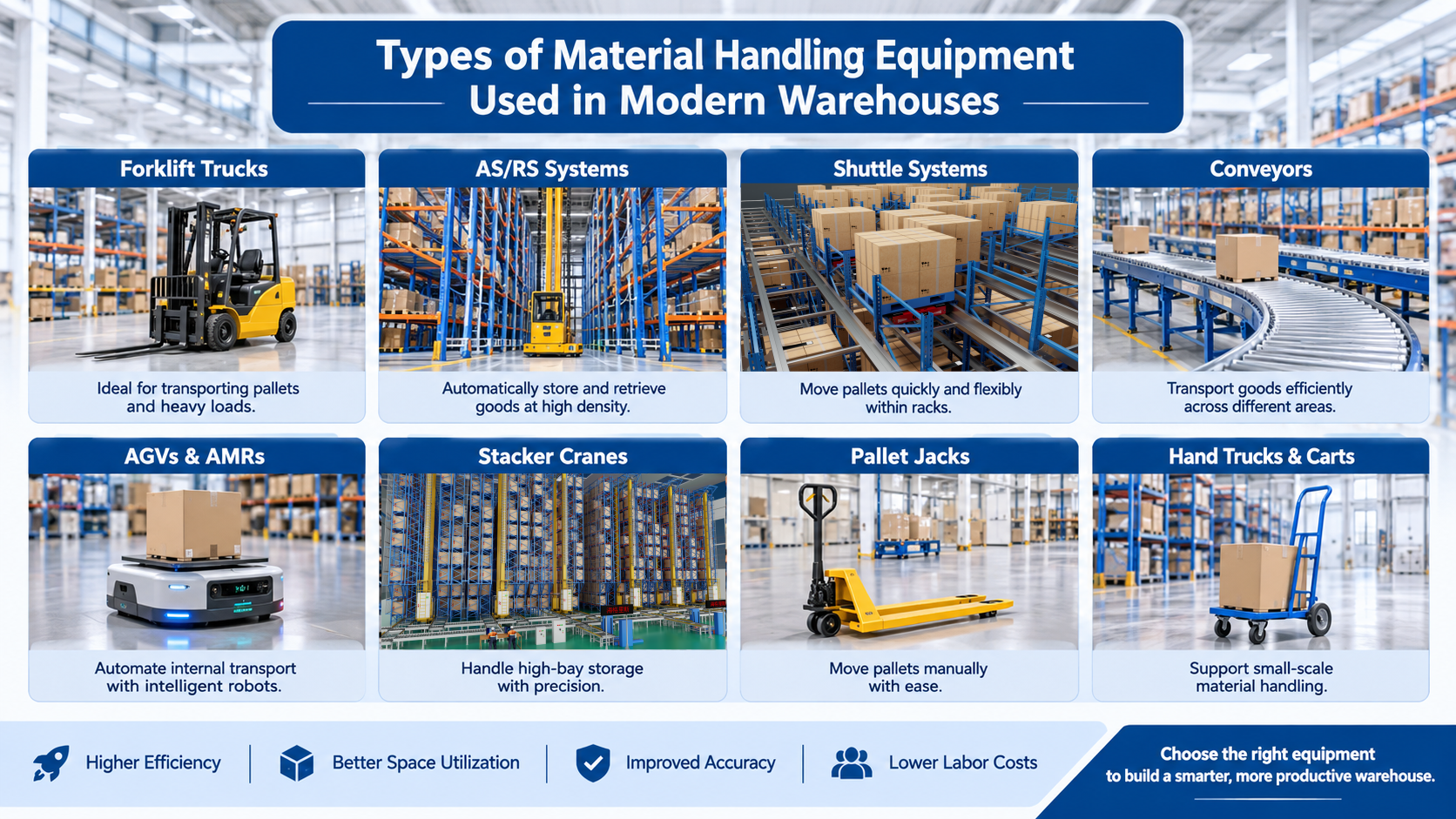
Material handling equipment moves goods between different warehouse areas, including receiving, storage, picking, packing, and shipping.
Common examples include:
-
Forklifts: Lift, carry, and stack palletized loads.
-
Pallet trucks: Move pallets over short distances.
-
Hand trucks and platform carts: Transport cartons and smaller loads.
-
Tow tractors: Pull multiple carts or trailers.
-
Conveyors: Move cartons, pallets, and other materials along defined routes.
-
AGVs: Transport materials automatically using programmed routes or navigation systems.
-
AMRs: Use sensors and navigation technology to move through operating environments and perform transport tasks.
The choice of equipment depends on load characteristics, transportation distance, handling frequency, and warehouse traffic conditions.
2.3 Warehouse Lifting Equipment
Lifting equipment raises, lowers, or positions goods at different heights.
Typical warehouse lifting equipment includes:
-
Stacker cranes: Automatically store and retrieve loads in high-bay racking systems.
-
Electric stackers: Lift and move palletized goods over relatively short distances.
-
Hoists: Raise or lower heavy materials.
-
Scissor lift tables: Adjust the working height of loads.
-
Industrial lifts: Transfer materials between different floor levels.
-
Vertical lift systems: Move goods vertically to improve space utilization and accessibility.
Stacker cranes are especially relevant to automated high-bay warehouses, where they travel along storage aisles to access multiple rack levels.
2.4 Warehouse Loading and Unloading Equipment
Loading and unloading equipment supports the transfer of goods between trucks, loading docks, and warehouse operating areas.
Common examples include:
-
Dock levelers
-
Loading ramps
-
Forklifts
-
Electric pallet trucks
-
Loading conveyors
-
Dock lifts
-
Truck loading and unloading systems
Dock levelers help bridge height differences between the loading dock and vehicle bed, while forklifts and pallet trucks move goods between vehicles and warehouse staging areas.
The right configuration depends on vehicle types, dock design, load dimensions, and daily shipment volume.
2.5 Warehouse Picking and Sorting Equipment
Picking and sorting equipment supports order fulfillment by helping operators or automated systems identify, collect, and organize products.
Examples include:
-
Order picking carts
-
Picking trolleys
-
Pick-to-light systems
-
Put-to-light systems
-
Automated sorting systems
-
Picking conveyors
-
Goods-to-person systems
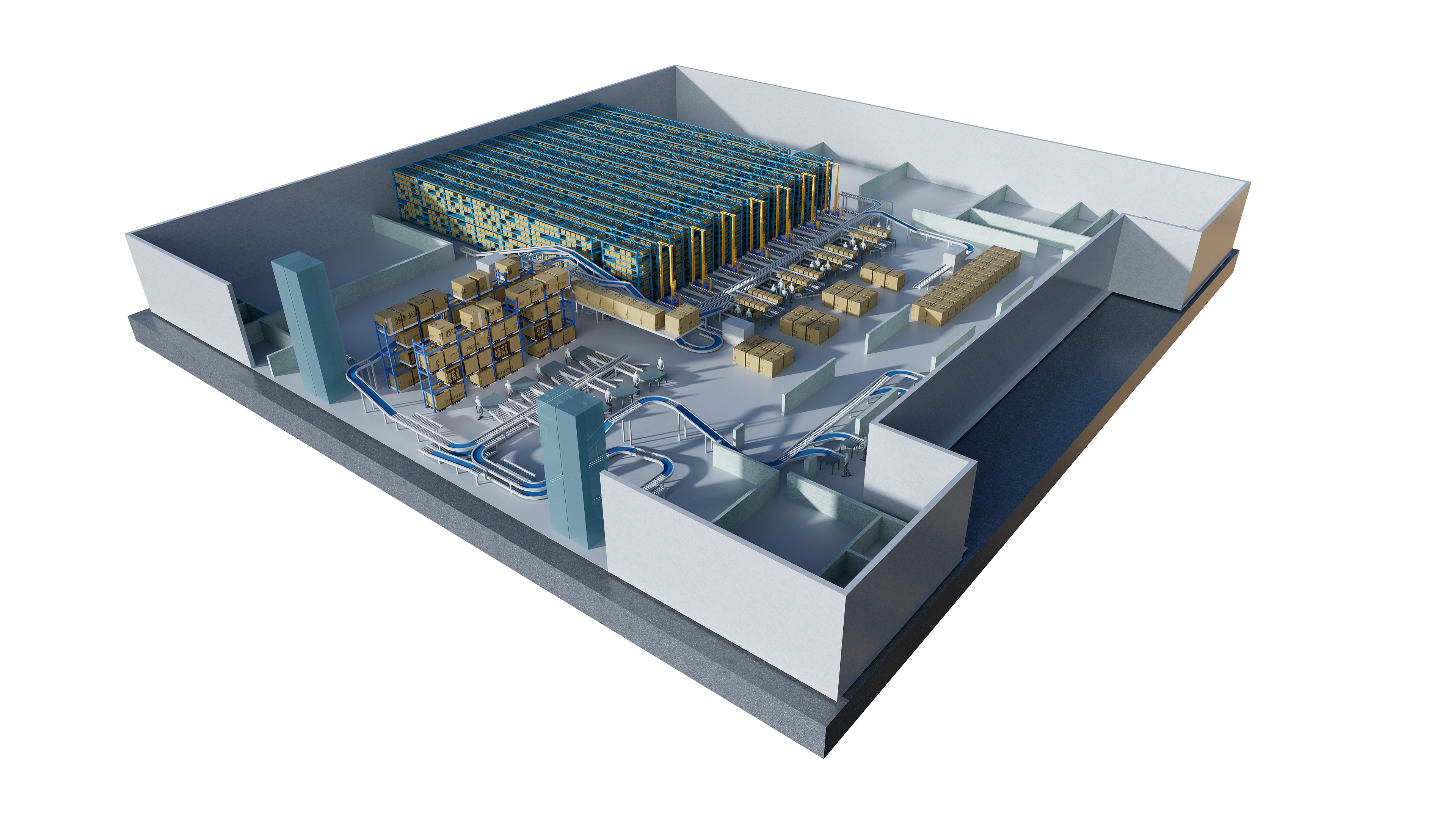
In a conventional warehouse, operators may walk through storage aisles to collect products. In a goods-to-person system, automated picking equipment brings inventory to a picking workstation, reducing the need for operators to travel between storage locations.
Automated sorting systems can also direct packages to different destinations according to order, shipping route, or other operational requirements.
2.6 Warehouse Packaging Equipment
Packaging equipment prepares goods for storage, transportation, and delivery.
Common types include:
-
Carton sealing machines
-
Stretch wrapping machines
-
Strapping machines
-
Labeling machines
-
Palletizers
-
Depalletizers
These machines help standardize packaging operations and prepare completed orders for shipment. They are often integrated with conveyors and sorting systems in distribution centers.
3. Warehouse Equipment List: Common Equipment and Their Uses
The following warehouse equipment list provides an overview of commonly used machines and systems.
| Warehouse Equipment | Main Function | Typical Application |
| Pallet racking | Stores palletized goods | Warehouse inventory storage |
| Shelving | Stores smaller items | Parts and carton storage |
| Forklift | Lifts and transports loads | Loading and pallet handling |
| Pallet truck | Moves pallets | Receiving and dispatch |
| Conveyor | Transfers materials | Internal material flow |
| Stacker crane | Automated storage and retrieval | High-bay warehouses |
| Four-way shuttle | Moves pallets within rack systems | High-density storage |
| AGV | Automated transportation | Repetitive material movement |
| AMR | Flexible mobile transportation | Dynamic warehouse workflows |
| Dock leveler | Bridges dock and vehicle height differences | Loading and unloading |
| Order picker | Supports elevated picking tasks | Case and piece picking |
| Sorter | Directs goods to different destinations | Distribution centers |
| Palletizer | Arranges products onto pallets | Packaging and shipping |
Not every warehouse needs all these machines. A small storage facility may only require shelving, pallet racking, and basic handling equipment. A large distribution center may combine automated storage, conveyors, mobile robots, and sorting systems.
4. Traditional vs. Automated Warehouse Equipment
Warehouse equipment can also be classified by its level of automation.
4.1 Traditional Warehouse Equipment
Traditional warehouse operations rely mainly on operators to control equipment and move goods.
Common examples include:
-
Manual pallet trucks
-
Forklifts
-
Electric stackers
-
Conventional pallet racking
-
Manual picking carts
-
Basic conveyor systems
These solutions can be suitable for warehouses with moderate throughput, relatively simple workflows, or limited automation budgets.
Their flexibility is useful when product types, storage arrangements, and operating requirements change frequently. However, labor requirements and equipment travel distances may increase as warehouse operations grow.
4.2 Automated Warehouse Equipment
Automated warehouse equipment uses mechanical systems, sensors, control software, and automated vehicles to perform storage and material handling tasks.
Examples include:
-
Automated Storage and Retrieval Systems (AS/RS)
-
Stacker crane systems
-
Automated conveyors
-
AGVs and AMRs
-
Automated sorting systems
-
Automated pallet handling equipment
These systems can support higher storage density, more consistent material flow, and coordinated warehouse operations.
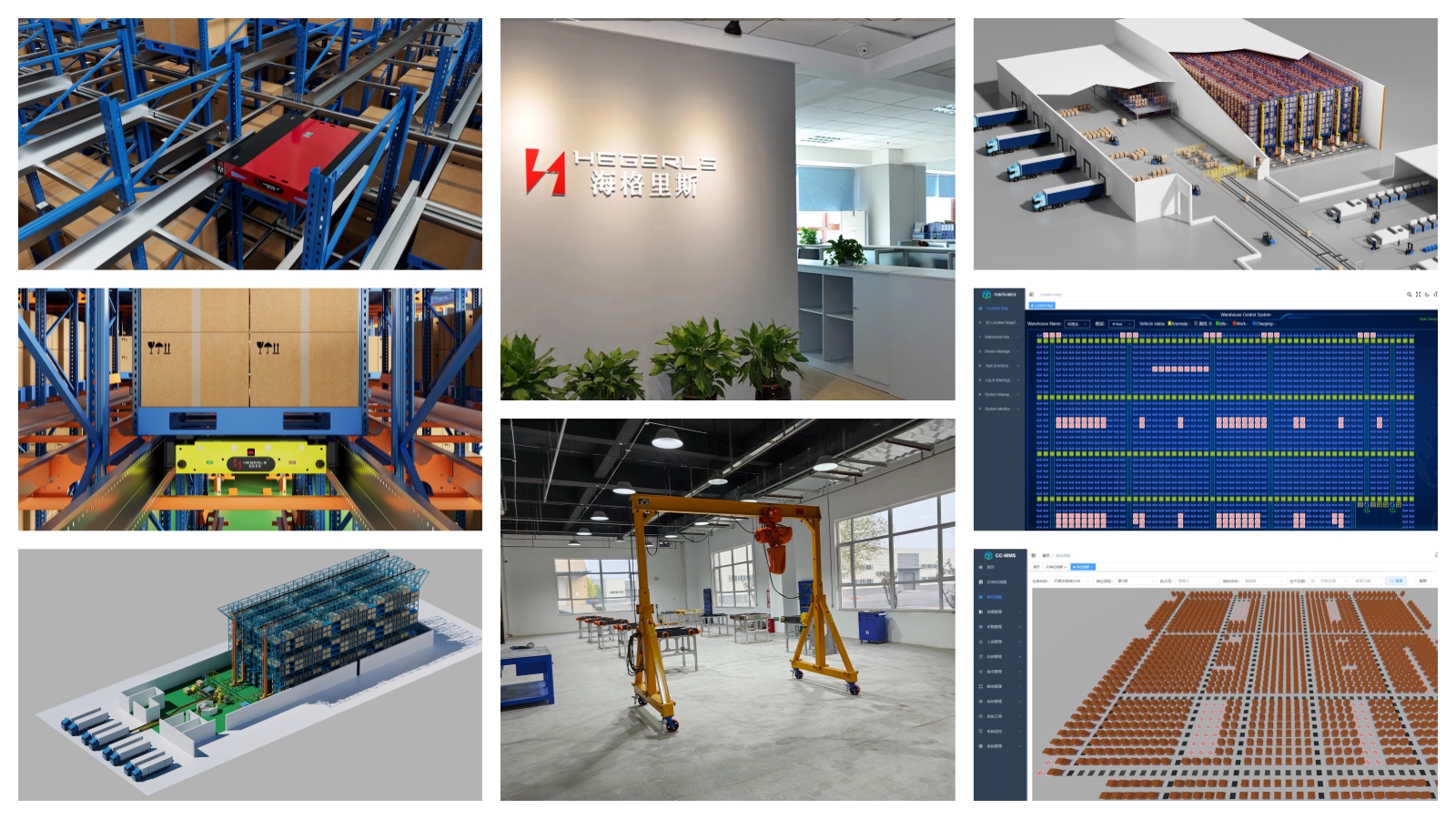
For example, a four-way shuttle system can move pallets horizontally within a rack structure, while lifting equipment transfers them between different levels. A warehouse control system coordinates equipment tasks according to the overall storage and retrieval workflow.
4.3 How to Choose Between Traditional and Automated Equipment
The choice should be based on operational requirements rather than automation level alone.
| Consideration | Traditional Equipment | Automated Equipment |
| Initial investment | Generally lower | Generally higher |
| Labor requirements | More operator involvement | Reduced manual intervention |
| Storage density | Depends on layout and access aisles | Can support high-density configurations |
| Operational flexibility | Often easier to adapt manually | Depends on system design |
| Throughput | Suitable for many small and medium operations | Suitable for consistent, high-volume workflows |
| Software integration | May be limited | Often requires WMS/WCS integration |
Many warehouses use a hybrid approach, combining conventional equipment with selected automated systems to address their most demanding processes.
5. Essential Warehouse Equipment for Different Operations
The equipment required varies across different stages of warehouse operations. Understanding the complete workflow helps businesses avoid selecting machines that work independently but do not support an efficient overall process.
5.1 Receiving and Unloading
When goods arrive, loading dock equipment, forklifts, pallet trucks, and conveyors help transfer products from delivery vehicles into the warehouse.
Receiving operations may also include inspection, labeling, weighing, and inventory registration.
5.2 Storage and Inventory Management
After receiving, goods are assigned to storage locations.
Depending on inventory characteristics, the warehouse may use selective pallet racking, drive-in racking, shuttle racking, shelving, or AS/RS.
The storage system should balance storage capacity, product accessibility, and inventory turnover requirements.
5.3 Internal Material Transportation
Conveyors, forklifts, pallet trucks, AGVs, and AMRs move materials between warehouse zones.
For repetitive transportation routes, automated equipment may reduce unnecessary manual travel. For irregular or changing workflows, flexible mobile equipment may be more appropriate.
5.4 Order Picking and Sorting
Picking equipment helps operators or automated systems collect the required products. Conveyors and sorters then transfer and organize completed orders for packing or dispatch.
The most suitable configuration depends on order volume, SKU count, product size, and picking methods.
5.5 Packing and Shipping
Packaging machines, palletizers, conveyors, and loading equipment prepare completed orders for shipment.
A well-designed shipping area should coordinate packaging capacity, staging space, vehicle access, and outbound schedules.
6. How to Choose the Right Warehouse Equipment
Selecting warehouse equipment requires a clear understanding of the facility and its operational objectives.
6.1 Evaluate Warehouse Size and Layout
Consider the available floor area, building height, aisle width, column positions, floor conditions, and loading dock configuration.
A high-bay warehouse may benefit from stacker cranes or shuttle-based storage systems. A warehouse with limited floor space may need to prioritize storage density and efficient traffic planning.
6.2 Consider Product Characteristics and Load Capacity
Equipment must be compatible with the materials being handled.
Important factors include:
-
Load weight and dimensions
-
Pallet type and size
-
Carton and container specifications
-
Product fragility
-
Storage and operating temperature
-
Special handling requirements
For example, heavy palletized loads may require forklifts or automated pallet storage systems, while small components may be better suited to shelving, bins, and goods-to-person picking systems.
6.3 Match Equipment to Throughput Requirements
Estimate inbound and outbound volumes, peak-hour demand, storage and retrieval frequency, and order picking requirements.
Equipment capacity should support normal operations as well as expected peak periods.
6.4 Consider Safety and Maintenance
Evaluate operator training, load stability, pedestrian traffic, equipment protection, emergency stop functions, and maintenance access.
For automated equipment, also consider navigation safety, obstacle detection, traffic coordination, and system monitoring.
6.5 Evaluate Budget and Total Cost of Ownership
The purchase price is only one part of the investment.
Also consider installation, infrastructure modifications, software integration, energy consumption, maintenance, spare parts, training, and potential downtime.
A suitable warehouse equipment solution should deliver value throughout its operating life rather than simply minimize initial costs.
7. Warehouse Equipment and Software Integration
In modern automated warehouses, equipment and software must work together to coordinate inventory and material movement.
Three important software components are commonly involved.
7.1 Warehouse Management System (WMS)
A Warehouse Management System manages inventory information and warehouse operations, including:
-
Receiving and putaway
-
Inventory tracking
-
Storage location management
-
Picking and order processing
-
Outbound operations
A WMS helps determine what needs to be stored, retrieved, picked, or shipped.
7.2 Warehouse Control System (WCS)
A Warehouse Control System coordinates automated equipment and operational tasks.
It can manage communication and task execution across systems such as:
-
Stacker cranes
-
Shuttle vehicles
-
Conveyors
-
Automated lifts
-
Sorting equipment
The WCS translates warehouse tasks into equipment-level instructions and helps coordinate the movement of goods.
7.3 How Warehouse Equipment Is Integrated
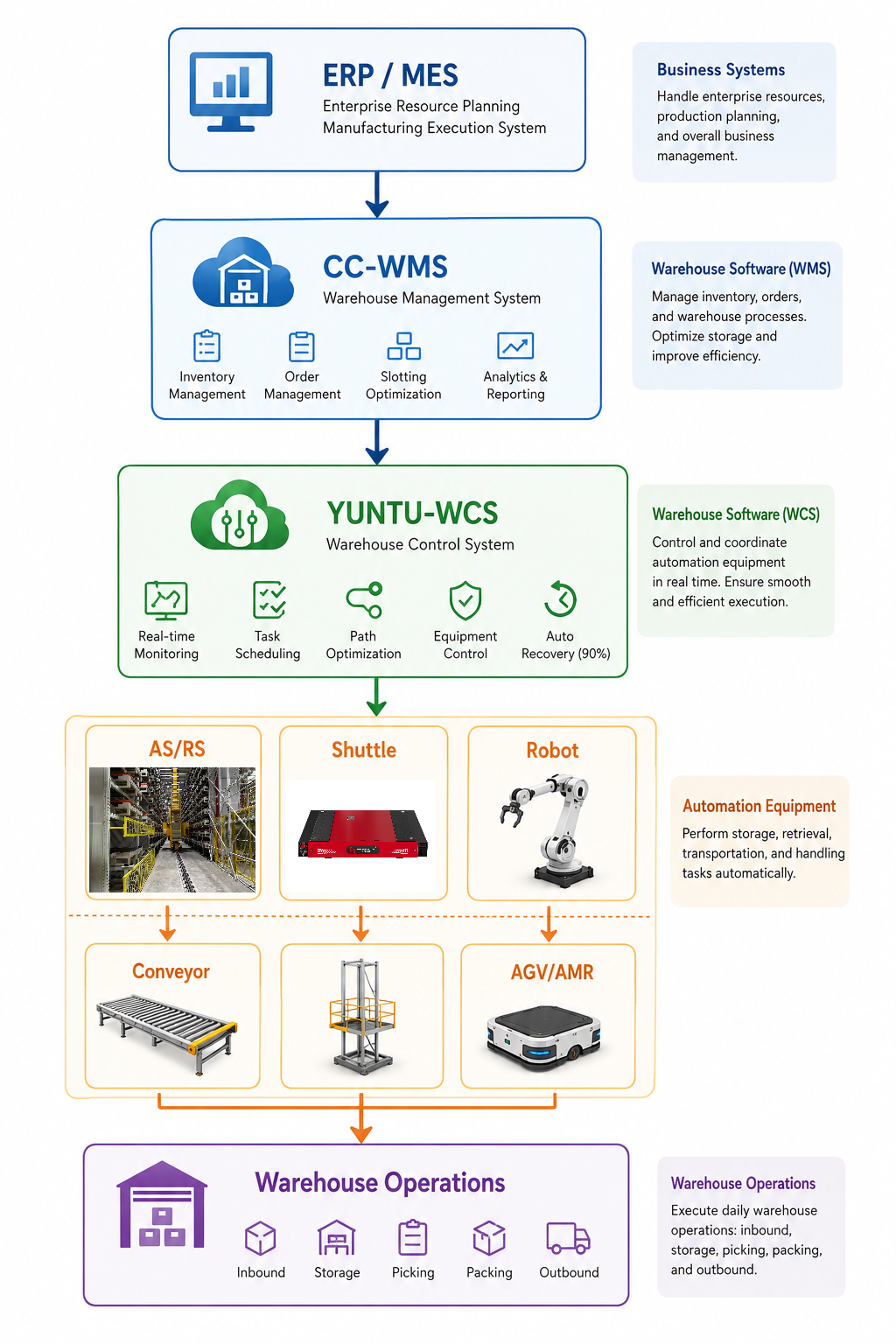
A typical automated warehouse architecture may follow this structure:
ERP/MES → WMS → WCS → Automated Equipment
The ERP or MES provides business and production requirements. The WMS manages inventory and warehouse tasks. The WCS coordinates equipment operations, while automated machines carry out storage, retrieval, transportation, and sorting activities.
The exact architecture depends on the project, equipment configuration, and software integration requirements.
Explore Zhuku's CC-WMS Warehouse Management System and YUNTU-WCS Warehouse Control System to learn more about warehouse software integration.
8. How to Choose a Warehouse Equipment Supplier or Manufacturer
Selecting a warehouse equipment supplier involves evaluating technical capabilities, project experience, and long-term support.
Before making a decision, consider the following:
Product range: Does the supplier offer equipment that matches your storage, handling, and automation requirements?
Engineering capabilities: Can the supplier assess warehouse layouts and recommend a suitable system configuration?
Customization and integration: Can the equipment work with existing racks, conveyors, software, and other warehouse systems?
Manufacturing and quality management: Are production processes, component quality, and relevant certifications clearly documented?
Project experience: Does the supplier have experience with similar warehouse sizes, load types, and operating conditions?
Installation and after-sales support: Are commissioning, training, spare parts, maintenance, and technical support available?
For complex projects, it is important to evaluate the supplier's ability to coordinate multiple equipment types as part of an integrated warehouse solution.
Conclusion: Build an Efficient Warehouse with the Right Equipment
Warehouse equipment supports every stage of warehouse operations, from receiving and storage to picking, packing, and shipping. The right combination of storage systems, material handling machines, and automation technologies can help businesses improve space utilization and create more coordinated material flows.
For warehouses with growing inventory volumes or complex operating requirements, integrating storage equipment with automated handling systems and warehouse software can provide a scalable approach to operational improvement.
Zhuku specializes in warehouse storage and automation solutions, including four-way shuttle systems, stacker crane systems, and integrated warehouse software. If you are planning a new warehouse or upgrading an existing facility, share your warehouse layout, load specifications, and throughput requirements with our team to explore a suitable solution.
Explore Zhuku's Four-Way Shuttle System and Automated Storage Systems.